
Staff Reporter:
Bangladesh’s external debt has nearly tripled over the past decade, reaching $113.43 billion at the end of 2025, equivalent to around Tk14.18 lakh crore at an exchange rate of Tk125 per US dollar, according to a World Bank report.
The country’s total external debt stood at $38.77 billion in 2015. It increased to $113.43 billion by the end of 2025, reflecting a substantial rise in the government’s and private sector’s foreign borrowing.
The figures were revealed in the World Bank’s International Debt Report 2026. The report said Bangladesh’s external debt stock increased by 8.6 per cent in 2025 compared with the previous year, indicating that the overall debt burden continued to grow despite repayments and other adjustments.
According to the report, a significant portion of Bangladesh’s external debt is owed to multilateral development partners, including the World Bank and the Asian Development Bank (ADB).
The country’s total outstanding debt to these institutions stood at $51.14 billion. Of this amount, Bangladesh owed $22.63 billion to the World Bank and $17.51 billion to the ADB.
Bangladesh also has substantial bilateral debt to countries including Japan, China, India and Russia. Its total outstanding debt to these countries amounted to $32.64 billion.
Japan was the largest bilateral creditor, with $12.72 billion owed to it, while Bangladesh’s outstanding debt to Russia stood at $9.02 billion.
In addition to public-sector borrowing, the private sector had nearly $10 billion in external debt. The country also had around $15 billion in short-term external liabilities.
Despite the sharp rise in external debt, some indicators of Bangladesh’s repayment capacity remain relatively manageable, the World Bank report said.
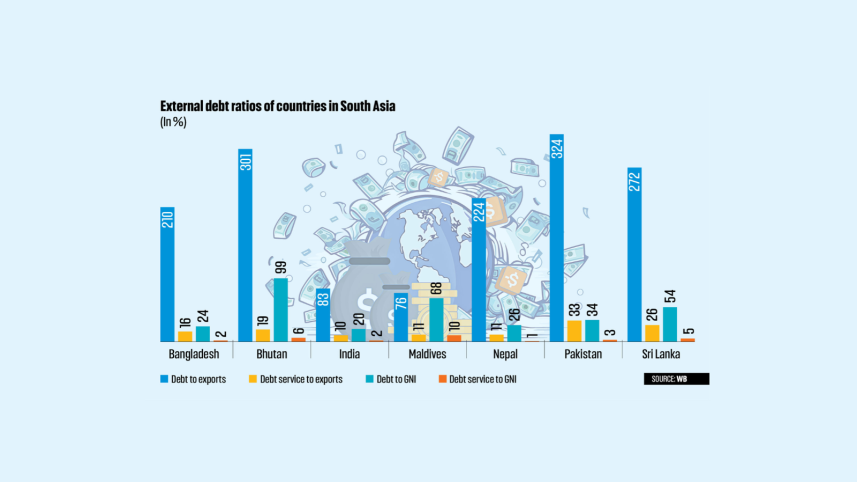
The country’s external debt-to-gross national income (GNI) ratio stood at 24 per cent, an increase of around six percentage points from the previous year.
However, the ratio of external debt service to export earnings declined to 16 per cent, down 3.8 percentage points from the previous year.
This means Bangladesh spends $16 out of every $100 earned from exports on repaying external loan principal and interest. The decline in this ratio is considered a relatively positive indicator of the country’s debt-servicing capacity.
Alongside the growth in outstanding external debt, the amount Bangladesh spends on repayments has also increased significantly.
According to data from the Economic Relations Division (ERD), Bangladesh paid $1.10 billion in external debt principal and interest in the 2012-13 fiscal year. The amount rose to $2.01 billion in 2021-22 and reached nearly $3 billion in 2022-23.
In the 2025-26 fiscal year, the country spent around $4.5 billion on external debt principal and interest payments.
As a result, the annual debt-servicing amount increased more than fourfold over 14 years.
Bangladesh may face greater pressure to repay external loans in the coming years as repayment schedules for several major infrastructure and development projects approach.
Repayments for loans taken to finance the Rooppur Nuclear Power Plant and the third terminal of Hazrat Shahjalal International Airport are expected to begin soon. A significant portion of these loans is owed to Japan.
Meanwhile, Bangladesh has already started repaying loans for the Karnaphuli River Tunnel and metro rail projects.
The growing repayment obligations are likely to put additional pressure on the country’s foreign exchange resources, particularly as the government continues to meet debt-servicing commitments alongside other external payment requirements.
What do you feel about this post?

Like

Love

Happy

Haha

Sad