
Tanvir Raihan:
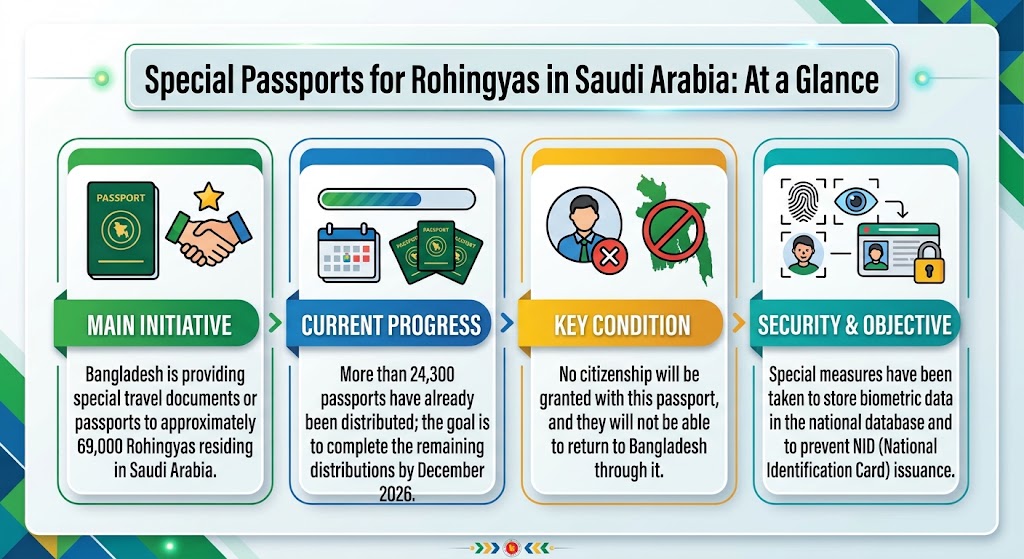
Bangladesh is issuing special passports to 69,000 Rohingyas living in Saudi Arabia, with more than 24,300 documents already delivered and the remaining passports expected to be distributed by December 2026. The move seeks to address expired travel documents while allowing Saudi authorities to verify the identities of the Myanmar nationals without granting them Bangladeshi citizenship.
The initiative highlights the diplomatic and administrative challenges Bangladesh faces in dealing with Rohingyas who travelled to Saudi Arabia decades ago using handwritten Bangladeshi passports. Many of those documents have since expired, prompting Saudi authorities to press Dhaka for their renewal.
An official at the Ministry of Home Affairs said preparations were underway to complete the remaining passports within the stipulated timeframe.
Additional Secretary Ziauddin Ahmed, who oversees the ministry’s immigration-related activities, said more than 24,000 passports had already been issued and the authorities were preparing to distribute the rest.
He stressed that the documents were not ordinary Bangladeshi passports issued to citizens. Instead, they were a special form of travel and identity documentation that would not confer Bangladeshi citizenship or entitle the holders to return to Bangladesh using those passports.
A meeting at the Ministry of Home Affairs on September 23 reviewed the outstanding cases and discussed steps to complete the process, according to ministry sources.
The issue gained renewed attention after the formation of the BNP government. In April, Saudi Ambassador to Bangladesh Abdullah Zafar bin Abiyah met Home Minister Salahuddin Ahmed at the Secretariat and raised the matter of issuing special passports to approximately 69,000 Myanmar nationals living in Saudi Arabia.
The ambassador reportedly urged Bangladesh to expedite the process.
The home minister said at the time that passports had already been issued to 22,000 Rohingyas after verification of the necessary information and evidence. He added that a special team had been sent from Bangladesh to accelerate the process and that applications meeting the required documentary conditions would be processed quickly.
A ministry official, speaking on condition of anonymity, said the government initially sought to avoid renewing the documents but eventually had to consider broader national interests, including the potential consequences for Bangladesh’s labour market in Saudi Arabia.
Saudi Arabia is a major destination for Bangladeshi migrant workers, making the management of bilateral relations an important consideration in decisions involving travel documentation and immigration.
The special passports are reportedly being issued with designated serial numbers. Biometric information, including fingerprints, iris scans and facial photographs, is being stored in the national database to facilitate identification at airports and other checkpoints.
Officials have also introduced safeguards intended to prevent the passport holders from obtaining Bangladeshi national identity cards. The nationality section of the documents reportedly records their status as people displaced from Myanmar.
These measures are intended to distinguish the passport holders from Bangladeshi citizens and help authorities verify their identities.
However, questions remain about the long-term administrative implications of maintaining reliable identity records for a population whose legal and nationality status differs from that of Bangladeshi citizens.
Asif Munir, an expert on migration and refugee affairs, said Bangladesh had found itself in a difficult position because many of the Rohingyas had obtained Bangladeshi passports years ago and subsequently travelled to Saudi Arabia.
With those documents expiring, the question of replacement became unavoidable, he said.
Munir noted that allegations had surfaced that some individuals obtained their earlier passports through irregular means. This was one reason Bangladesh had initially been reluctant to renew them.
He said Saudi Arabia also had an interest in establishing the identities of these residents for security and immigration-management purposes.
“Bangladesh has to balance its obligations arising from the existing situation with the need to protect its national interests,” Munir said, describing the circumstances surrounding the passport initiative.
He added that the documentation could help Saudi authorities maintain reliable identity records and monitor the legal status of the individuals concerned.
Munir expected most of the passport holders to remain in Saudi Arabia rather than return to Bangladesh, although their future movements would depend on their individual circumstances and applicable immigration rules.
The initiative therefore represents more than a passport-renewal exercise. It involves questions of identity verification, migration management, bilateral relations and the protection of Bangladesh’s interests in a major overseas labour market.
The government’s challenge will be to complete the process while ensuring that the special documents are not mistaken for proof of Bangladeshi citizenship and that the identity-verification safeguards remain effective.
What do you feel about this post?

Like

Love

Happy

Haha

Sad