Tanvir Raihan:
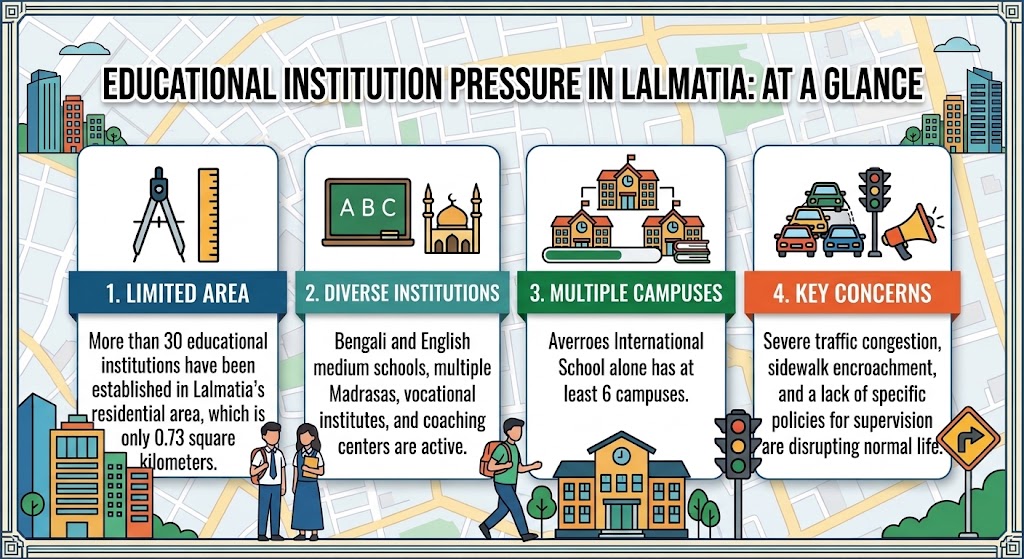
Lalmatia, once known for its quiet residential environment, is increasingly becoming a hub for educational institutions, putting pressure on local roads, footpaths and everyday life. A field visit to the Dhaka neighbourhood found more than 30 schools, colleges, madrasas, coaching centres and specialised educational facilities within a small area, raising questions about urban planning, regulatory oversight and the capacity of residential zones to accommodate growing educational demand.
According to the Rajdhani Unnayan Kartripakkha (RAJUK), Lalmatia Residential Area covers just 0.73 square kilometres. Yet its streets and residential blocks host institutions offering Bangla-medium, English-medium and religious education, alongside coaching centres and specialised training facilities.
The rapid expansion has increased educational options for families, but residents say the concentration of institutions is affecting traffic movement, pedestrian access and the area’s residential character.
A field survey found numerous institutions operating close to one another, with some organisations maintaining multiple campuses. At least six campuses of Averroes International School were identified in Lalmatia.
However, a comprehensive official count of educational institutions in the area, including their registration status, authorised campuses and curricula, was not available. The absence of consolidated information has raised concerns about how effectively the institutions are being monitored.
Lalmatia hosts several public and private institutions, including Lalmatia Government Women’s College, Government Lalmatia Housing Society Higher Secondary School, Lalmatia Government Primary School, Lalmatia Girls High School and College, Foundation School and College, Bengali Medium High School and Shohoj Path High School.
English-medium and international schools include Averroes International School, Kookaburra Australian Standard School, St Paul’s School, Academia, Oxford International School, Education International School, Weton International School, Crestwood English Medium School, Mangrove School, British Columbia School, Excellence International School, Legend International School and Premier School, Dhaka.
The area also has religious institutions such as Jamia Islamia, Madrasa Nur-e-Madina, Mashqul Quran, Madrasatul Kalam and Islamia Madrasa. Other educational and training facilities include Shanto-Mariam Institute of Creative Technology, Future Barristers Academy and several coaching centres.
Nearby institutions, including Government Graphic Arts Institute, Government College of Physical Education, Daffodil International College, the University of Development Alternative and St Joseph Higher Secondary School, add to the daily movement of students, teachers and guardians in the wider neighbourhood.
Residents say congestion is particularly severe when classes begin and end, while pressure on roads and footpaths disrupts normal movement.
Belal Ahmed, president of the security committee of Lalmatia Housing Society, said the growing number of English-medium schools and coaching centres had made life increasingly difficult for residents.
“The number of coaching centres and English-medium schools in Lalmatia has increased so much that residents have, in many ways, become hostages to the situation. These institutions are disrupting our normal lives,” he said.
Ahmed called for clear guidelines on how many institutions should be allowed in the area, where they could operate and how their activities should be regulated.
Questions have also emerged over the registration and approval status of some institutions.
The activities of Peace School in Lalmatia’s D Block have drawn renewed attention from residents. In August 2016, the Education Ministry directed the cancellation of teaching permission for Peace International School in Lalmatia following allegations of controversial activities. The Dhaka Education Board subsequently cancelled the school’s provisional registration.
Residents say the previous building was later demolished and Averroes International School was established at the site. Some locals allege that individuals associated with the former school later became involved with new educational institutions. They have called on the authorities to verify the registration and approval status of the Peace School currently operating in D Block.
These allegations require verification by the relevant authorities and responses from the institutions concerned.
Differences in official accounts of regulatory responsibilities have added to concerns about oversight.
Professor Dr Khan Moynuddin Al Mahmud Sohel, director general of the Directorate of Secondary and Higher Education (DSHE), said the Dhaka Education Board was responsible for English-medium schools’ approval and recognition, including decisions concerning their operation.
However, Professor Syed Akhtaruzzaman, chairman of the Dhaka Education Board, said the authority to approve English-medium schools was no longer within the board’s jurisdiction and that the ministry now handled such approvals. He said the board primarily dealt with examinations, registration, forms and examination-related irregularities.
On the presence of multiple institutions in the same area or building, Akhtaruzzaman said approvals were granted based on demand. Several institutions could operate in the same building in urban areas, where student demand remained strong. He added that complaints against institutional management committees could be investigated and appropriate action taken.
The differing explanations highlight the need for greater clarity about the division of responsibilities among regulatory agencies.
Mohammad Rahmat Ullah, a former college principal, educationist and children’s author, said the concentration of educational institutions in a small area reflected weaknesses in planning and coordination.
He said effective monitoring was needed to ensure standards in curricula, teacher qualifications, learning environments, fees and student safety across Bangla-medium, English-medium, Arabic-medium and other educational systems.
According to him, the separation of responsibilities among authorities overseeing general education, technical education and madrasas can create gaps in coordination. Inadequate quality in public and recognised institutions may also contribute to demand for new private schools.
Educationist Rasheda K. Chowdhury has similarly called for a more planned approach to establishing educational institutions. She said authorities should assess how many institutions are needed in different areas before granting approvals and strengthen monitoring capacity by increasing the necessary workforce.
Residents want the government to conduct a coordinated survey of institutions in Lalmatia, verify their registration and authorised campuses, and assess the neighbourhood’s capacity to accommodate them.
The challenge is to expand access to education without allowing the growth of institutions to undermine the safety, mobility and residential environment of the communities in which they operate.
What do you feel about this post?

Like

Love

Happy

Haha

Sad