Staff Reporter:
Prime Minister Tarique Rahman has called for grants instead of additional loans for countries vulnerable to climate change, warning that further borrowing is placing an unfair financial burden on nations already struggling with climate-related losses.
He also proposed that at least 50 per cent of international climate finance be allocated according to individual countries’ priorities to address climate impacts and reduce greenhouse gas emissions.
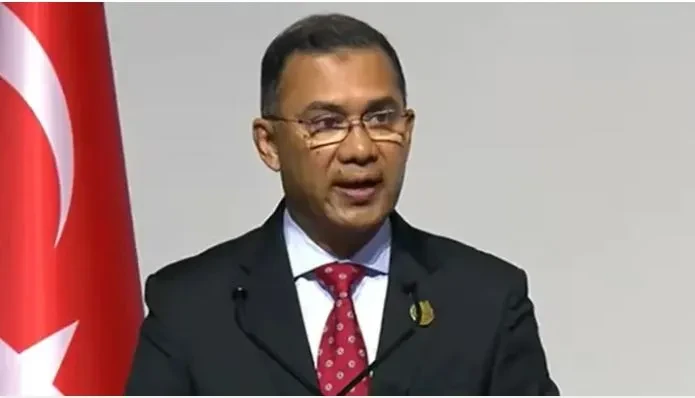
The prime minister made the proposals while addressing a high-level session of the United Nations Climate Change Conference, COP31, in Antalya, Türkiye, on Thursday (November 12).
Tarique Rahman said the global climate finance system remained inadequate to meet actual needs, particularly those of developing countries. Their priorities and requirements were not being adequately reflected in existing financing arrangements, he said.
Climate-related losses and damage were putting significant pressure on national economies, while additional debt-servicing obligations and limited financial resources were making the situation more difficult.
“Climate-vulnerable countries need grants, not more loans. They need reliable financial support, access to modern technology and stronger assistance for adaptation efforts,” he said.
Referring to the principle of Common but Differentiated Responsibilities and Respective Capabilities (CBDR-RC), the prime minister said Bangladesh was calling for five urgent measures.
He proposed allocating at least 50 per cent of international climate finance to address climate impacts based on each country’s national priorities, while also ensuring support for greenhouse gas emission reduction initiatives.
To ease the debt burden on climate-vulnerable countries, he proposed introducing special provisions such as Climate-Resilient Debt Clauses and debt-for-climate swaps.
He also called for equitable access to environmentally friendly climate technologies and adequate support for transferring such technologies to developing countries.
Emphasising the need for a fair energy transition, Tarique Rahman highlighted affordable financing, skills development and increased use of renewable energy.
He also proposed adopting a ‘Belém-Antalya Action Mechanism’ at COP31 to facilitate a just energy transition, identifying fair financing and equitable trade as its key foundations.
Highlighting Bangladesh’s climate vulnerabilities, the prime minister said the country was among those on the frontline of climate change, despite contributing less than 0.5 per cent of global greenhouse gas emissions.
Despite these challenges, he said, the Bangladesh government was committed to building a climate-resilient and sustainable economy worth one trillion dollars. He stressed the importance of pursuing economic growth alongside environmental protection.
The government has set a target of meeting 20 per cent of the country’s total electricity demand from renewable sources by 2030, he said.
He added that initiatives had been taken to generate 4,000 megawatts of solar power through special tax incentives, while the government was also encouraging energy production from waste.
The prime minister said Bangladesh currently had around 300 LEED-certified garment factories. The government was also working to expand environmentally friendly transport, including electric vehicles.
Other initiatives included promoting environmentally friendly products such as jute bags and developing a national framework for carbon trading.
Tarique Rahman further announced plans to plant 250 million trees over the next five years as part of the country’s environmental conservation efforts.
He said the government was also working on the Padma Barrage and Teesta Barrage master plans, alongside an initiative to excavate 20,000 kilometres of rivers and canals.
The projects are intended to increase water retention capacity, reduce flood risks, restore wetlands and improve groundwater levels.
He also said the government planned to restore mangrove forests on reclaimed coastal land to strengthen protection for coastal communities and improve climate resilience.
Concluding his speech, the prime minister expressed hope that COP31 would produce meaningful, balanced and ambitious decisions, particularly in the interests of countries most severely affected by climate change.
“Let us turn our commitments into action, strengthen global solidarity and collectively build a sustainable future,” he said.
COP31 is being held in Antalya, a Mediterranean coastal city in Türkiye known for its natural beauty and historic architecture. The 11-day conference began on Monday (November 9), bringing together heads of state and government, policymakers, researchers and delegates from around 190 countries, including Bangladesh.
The conference is hosted by Türkiye, with the country’s Minister of Environment, Urbanisation and Climate Change, Murat Kurum, serving as its president. Australia’s Minister for Climate Change and Energy, Chris Bowen, is chairing the conference negotiations.
One of the key events, the World Leaders’ Climate Action Summit, is taking place on November 11 and 12. Prime Minister Tarique Rahman is attending the summit.
Alongside participating in various sessions, he is holding bilateral meetings on the sidelines of the conference with heads of state and government, including Australian Prime Minister Anthony Albanese.
What do you feel about this post?

Like

Love

Happy

Haha

Sad