
Staff Reporter:
Bangladesh has observed November 7 as National Revolution and Solidarity Day at the state level for the first time in nearly 20 years, with programmes held across Dhaka and other parts of the country.
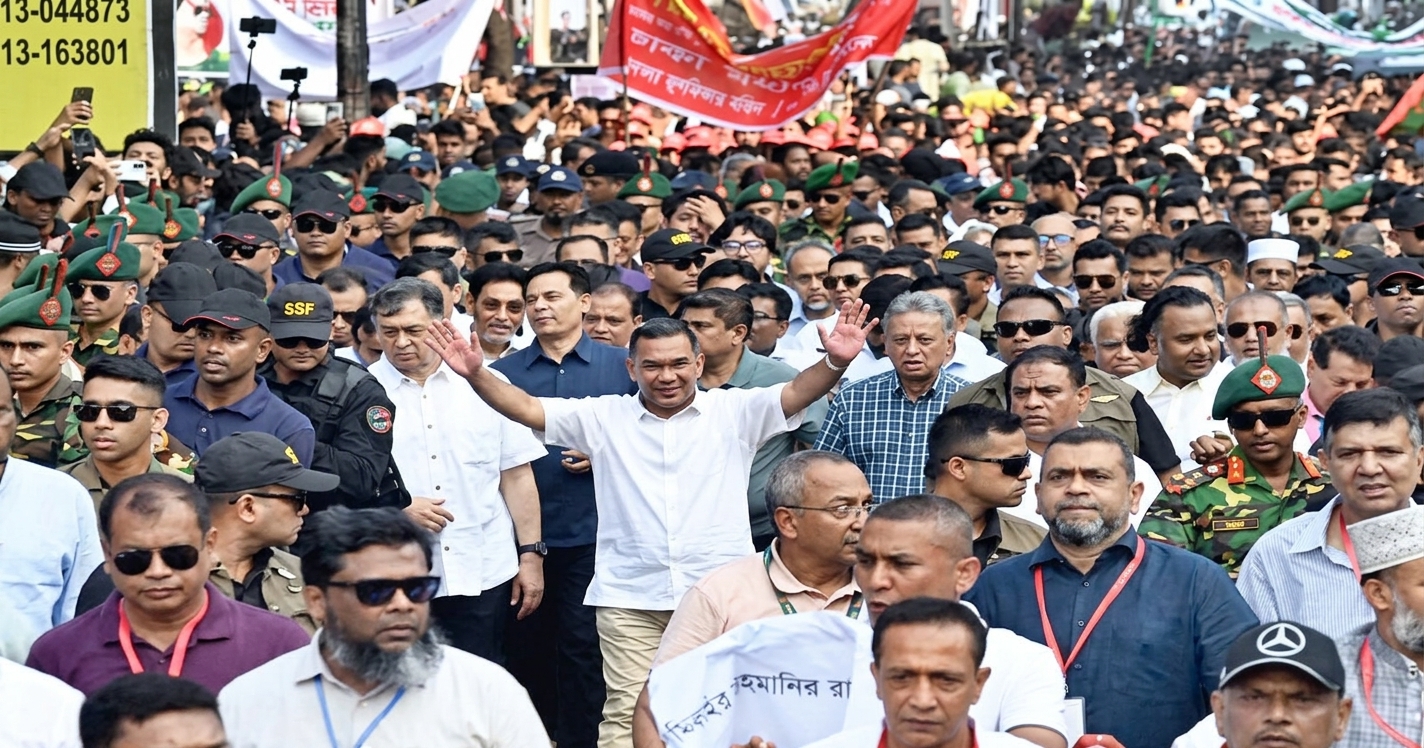
On Saturday (November 7), discussions, rallies, public gatherings, cultural programmes and other events were organised in different divisions, districts and upazilas to mark the occasion. One of the major events was a colourful procession led by Prime Minister Tarique Rahman, joined by leaders and activists of the Bangladesh Nationalist Party (BNP) and its affiliated organisations.
Prime Minister Tarique Rahman began the day’s programmes in the morning by visiting the graves of Shaheed President Ziaur Rahman and former Prime Minister Khaleda Zia. He later visited displays organised by the Bangladesh National Cadet Corps (BNCC), Bangladesh Scouts and other organisations at the Army Stadium. He also addressed a grand gathering of village police at the National Parade Ground as the chief guest.
The BNP procession started from Nayapaltan and proceeded through Kakrail, Ramna Park Road, the Hotel InterContinental intersection, Banglamotor, Farmgate and Indira Road before ending at Manik Mia Avenue. Prime Minister Tarique Rahman led the procession from the front. At different points along the route, members of the public were seen standing on both sides of the streets to greet him.
Organisers claimed that a large number of party leaders, activists and members of the public took part in the procession, which covered a distance of approximately six kilometres before reaching Manik Mia Avenue.
Historical background
November 7, 1975, is regarded as a significant date in Bangladesh’s political and military history. Following the military coup on November 3 that year, then army chief Ziaur Rahman was detained. He was subsequently released during the uprising involving soldiers and civilians on November 7. The events had a significant impact on the country’s subsequent political developments.
However, political parties and historians have different interpretations of the significance of the day. The BNP observes it as National Revolution and Solidarity Day and views it as a historic moment of unity between soldiers and civilians under the leadership of Ziaur Rahman.
According to published reports, state-level observance of the day was discontinued in 1996, when the BNP was out of power. It was reinstated in 2001 after the party returned to government but discontinued again in 2007 during the caretaker government. This year, the day was once again observed at the state level after a prolonged gap. The report also said the day had been classified as a ‘Class A’ national day and declared a public holiday.
Universities hold discussions
Various universities organised programmes to mark National Revolution and Solidarity Day.
At Bangladesh Agricultural University, Vice-Chancellor Professor Dr Md Rafiqul Islam Sardar, speaking at a discussion, said Shaheed President Ziaur Rahman had taken charge of the country during a critical period and led Bangladesh forward. He described Ziaur Rahman as a patriotic leader.
Khulna University of Engineering and Technology (KUET) organised an essay competition, discussion and prize-giving ceremony. Vice-Chancellor Professor Dr Muhammad Masud said the day reminded people of the importance of national unity, patriotism and collective responsibility. He called on everyone to work together for the country’s welfare.
Noakhali Science and Technology University Vice-Chancellor Professor Dr Golam Rabbani said the spirit of November 7 included developing a mindset of unity on national interests despite political differences.
At the University of Chittagong, a discussion was held on the historical background of the day and its significance in the country’s political history. Vice-Chancellor Professor Dr Mohammad Al-Forkan said the university would consider establishing a hall named after Shaheed President Ziaur Rahman.
Programmes across districts and upazilas
In Bogura, the district administration organised a discussion and a prize-giving ceremony for an art competition at Shaheed Titu Auditorium. The event was chaired by Deputy Commissioner Md Toufiqur Rahman, while Bogura-6 lawmaker and district BNP president Rezaul Karim Badsha attended as the chief guest.
Bogura-4 lawmaker Mosharraf Hossain, City Corporation Administrator M R Islam Swadhin and Superintendent of Police Mirza Sayem Mahmud attended as special guests.
In Kushtia, the district administration and the BNP organised discussions, rallies, public gatherings and traditional stick-fighting demonstrations. In Gaibandha, Religious Affairs Minister Shamim Kaiser Lincoln addressed a discussion at the local stadium auditorium.
Discussions and cultural programmes were also held in Sherpur, Natore, Gazipur and Sirajganj.
At an event organised at the District Shilpakala Academy in Sirajganj, Power, Energy and Mineral Resources Minister Iqbal Hasan Mahmud Tuku attended as the chief guest. He said Ziaur Rahman had established multiparty democracy. His remarks on Jamaat-e-Islami also brought political history into the discussion.
Besides, programmes were organised by local administrations, political parties and educational institutions in Patuakhali, Bhola, Nilphamari, Keshabpur in Jashore, Puthia, Ullapara, Raninagar, Parbatipur, Gafargaon, Muktagachha, Morelgonj, Monohargonj, Akhaura and Chirirbandar, among other areas.
Freedom fighters, government officials, political leaders and activists, teachers, students and local residents took part in the programmes in different places.
The observance featured discussions, essay and art competitions, prize-giving ceremonies, friendly football matches and cultural events.
What do you feel about this post?

Like

Love

Happy

Haha

Sad