
Tanvir Raihan:
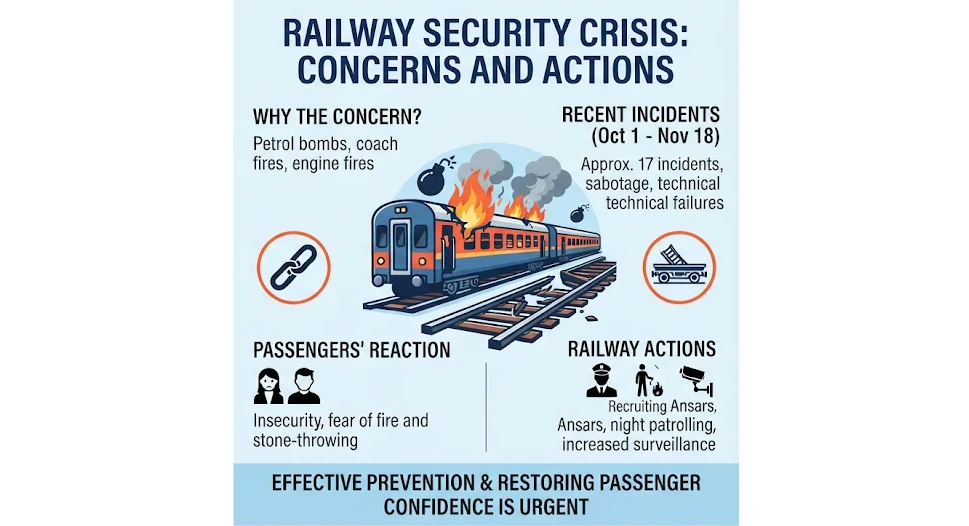
A series of fires, suspected acts of sabotage and operational accidents across the railway network has raised fresh concerns over passenger safety in Bangladesh. From petrol bomb attacks at railway stations and fires in passenger coaches to engine fires and derailments, the incidents have disrupted train services and heightened anxiety among passengers.
Between October 1 and November 18, around 17 such incidents were reported in different parts of the country. While some involved suspected sabotage or arson, others were attributed to mechanical faults or possible negligence. Although the causes varied, the incidents have brought the overall safety of railway operations under renewed scrutiny.
Recent incidents include petrol bomb attacks at stations, fires in train seats, burning tyres beside railway tracks and damage to equipment in train coaches. On November 9, a crude bomb exploded at the outer point of Gandaria Railway Station. The following day, a petrol bomb was thrown at the door of the stationmaster’s room at Chattogram Railway Station. On the same day, a fire was set on the railway tracks along the Daulatkandi-Meghna section, delaying the Chandpur Commuter train.
Several incidents involving railway property were reported on November 10. At Mohanganj Railway Station in Netrokona, the covers of four seats in a stationary coach of the Mohanganj Express were burnt. Tyres were set on fire beside the railway tracks near a level crossing at Jamalpur Station. At Chattogram Station, the hoses of several coaches of a university shuttle train were cut. A coach of the stationary Turag Commuter train at Joydebpur Station was also set on fire after petrol was poured inside.
A seat in a coach of the stationary Nakshikatha Express at Khulna Station also caught fire. However, the stationmaster suspected that a mosquito coil might have caused the blaze. This indicates that not all incidents reported around the same period can be classified as acts of sabotage; each requires a separate investigation to establish the actual cause.
On November 11, a coach of the Titas Commuter train was set on fire at Akhaura Railway Junction, burning 11 seats. Signs of an inflammable substance being splashed on an adjacent coach were also found. Two people were detained in connection with the incident.
Earlier, a fire broke out in an abandoned railway coach in the Banglabazar area of Chattogram city on October 2. On October 18, the engine of the Dhaka-bound Joyantika Express caught fire at Shayestaganj Railway Junction in Habiganj. Railway authorities detached the affected engine and restored services using a replacement engine.
Apart from suspected sabotage, mechanical failures and derailments have also disrupted railway operations. On October 21, four coaches of the Karnaphuli Commuter train derailed at Laksham in Cumilla. On October 29, a coach of the Nilsagar Express derailed at Mirzapur in Tangail, disrupting rail communication between Dhaka and the northern region. The following day, eight coaches of the Mohanganj Express became detached from the engine at Gafargaon.
On November 13, the engine of the Dhaka-bound Egarosindhur Express from Kishoreganj caught fire at Pubail in Gazipur, temporarily suspending train services. The train was later taken to Dhaka using a replacement engine. Bangladesh Railway formed a four-member committee to investigate the incident.
On the night of November 15, a petrol bomb was thrown at Barabazar Railway Station in Kaliganj, Jhenaidah, setting fire to the door of the stationmaster’s room. The latest incident occurred on November 17, when a fire was set at the abandoned Atitpur Railway Station in Barhatta, Netrokona.
The recurring incidents have raised concerns among regular rail passengers. Shahriar Ahmed Shuvo, a regular train commuter, said railway travel was more affordable and comfortable than many other modes of transport in Bangladesh. However, recent incidents of arson, sabotage and stone-throwing at moving trains had created a sense of insecurity among passengers.
The fire at the Titas Commuter train at Akhaura Station had further intensified those concerns, he said.
Another passenger, Nubayet Protyoy, said railways had traditionally been considered a safe and comfortable means of travel. But repeated incidents of sabotage and arson were making train journeys seem increasingly risky to many people.
He also questioned whether passengers could evacuate quickly and safely in an emergency, particularly if a fire broke out on a moving train.
Kazi Md Saifun Newaz, a transport expert and assistant professor at Bangladesh University of Engineering and Technology (BUET), said railway safety incidents posed a serious threat to both railway management and passengers, as thousands of people travelled by train at the same time.
He said railway security needed to be strengthened to the highest possible level.
The railway has its own security force, while police personnel also provide security patrols at times. However, there is scope for additional measures, he said, suggesting the installation of CCTV cameras in railway yards and inside and outside train coaches.
Such surveillance systems could help prevent not only arson but also incidents of stone-throwing at trains, he added.
Bangladesh Railway has announced several measures to strengthen security following the series of incidents.
Railway Director General and engineer Md Afzal Hossain said patrols along railway tracks had been introduced since last month, including night-time surveillance, to prevent sabotage and arson.
He said the measures were also intended to ensure that authorities received information quickly in the event of an incident so that train services could be suspended when necessary.
The director general said additional surveillance had been ordered by the Railway Nirapatta Bahini (RNB) at stations, workshop areas, train-washing facilities and other important installations where sabotage could cause extensive damage.
He also said the recruitment process for around 2,000 Ansar personnel was underway through the Ministry of Home Affairs.
The process was expected to be completed within November, with additional Ansar members scheduled to begin deployment at different locations from November 25. Railway authorities hoped to deploy the additional personnel at various locations before December.
Emphasising that passenger safety remained the top priority, Afzal Hossain said railway authorities were taking all possible measures to prevent loss of life and property.
He added that train services might have to be temporarily suspended in certain areas if the situation required it. Where regular security forces were unable to control a situation, authorities might need to restrict train operations to protect passengers.
The effectiveness of these measures will be crucial in restoring public confidence in railway travel. Increasing the number of security personnel and forming investigation committees after incidents may not be sufficient on their own. Authorities also need to strengthen preventive surveillance at vulnerable stations, yards and railway sections, improve fire-response preparedness and ensure that passengers can evacuate safely during emergencies.
Unless the causes of sabotage and operational accidents are identified separately and effective preventive measures are put in place, restoring passengers’ confidence in the railway system will remain a challenge.
What do you feel about this post?

Like

Love

Happy

Haha

Sad