Tanvir Raihan:
A country’s development cannot be measured solely by the number of bridges it builds, the height of its buildings or its per capita income. The real picture of progress emerges from the lives of its children: what they eat, what they learn, how safely they grow up and what opportunities they have for the future. These questions deserve renewed attention in Bangladesh.
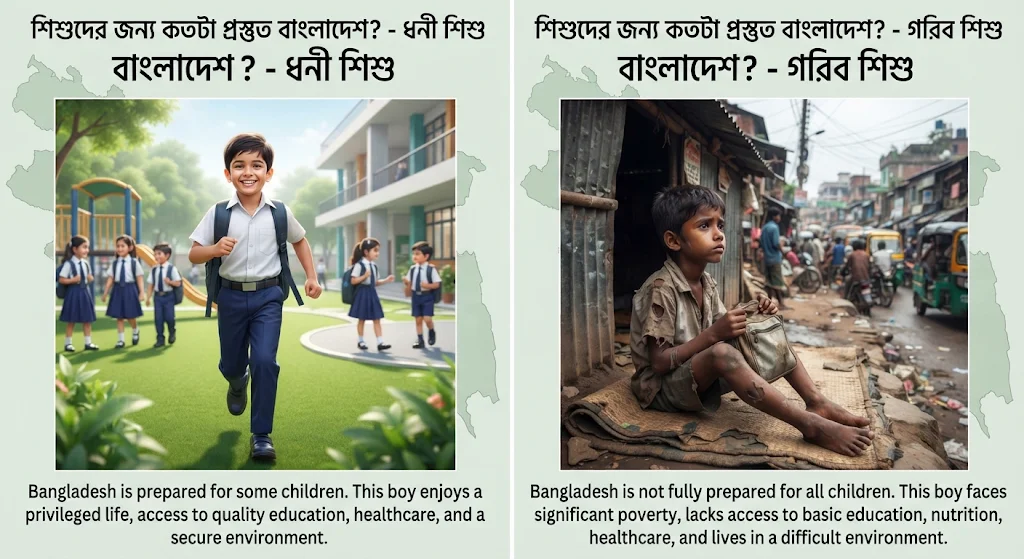
November 20 is World Children’s Day. Every year, the occasion draws attention to children’s rights, protection and well-being. Yet the reality is that childhood remains unsafe and uncertain for millions of children in the country. Some are entering the workforce instead of attending school because of poverty, others lack adequate nutrition, while many grow up exposed to violence and environmental risks.
According to Bangladesh’s first National Multidimensional Poverty Index, 28.9 per cent of the country’s children live in multidimensional poverty. Their deprivation goes beyond a lack of household income. Shortfalls in education, healthcare, nutrition, housing and access to essential services also restrict their development. This shows that economic growth does not automatically improve the quality of life for every child.
Education presents a similar picture of progress alongside serious shortcomings. School enrolment has increased, particularly at the primary level, but attending school and actually learning remain two different things. According to UNICEF, 51 per cent of children aged 7 to 14 cannot read a simple paragraph. This suggests that while access to education has expanded, quality learning remains a major challenge. Education should not be limited to passing examinations or obtaining certificates; it must develop children’s ability to think, analyse and solve problems.
A significant number of children who leave school are entering work because of financial pressures on their families. Preliminary findings of the 2025 Bangladesh Multiple Indicator Cluster Survey show that 9.2 per cent of children aged 5 to 17 are engaged in child labour, up from 6.8 per cent in 2019. The increase is concerning. Ending child labour requires not only stronger enforcement of laws but also better income security and social protection for poor families. Otherwise, removing a child from work without supporting the family could deepen its financial hardship.
The nutrition situation is equally worrying. A 2024 UNICEF report found that two out of every three children under five in Bangladesh experience child food poverty. Preliminary findings from the 2025 survey put the rate of wasting among children under five at 12.9 per cent. The survey also found concerning levels of lead in the blood of 38 per cent of children aged 12 to 59 months. Such problems can affect not only physical growth but also brain development and learning ability.
Child safety is another major concern. The same survey found that 86 per cent of children had recently experienced some form of violent discipline. This means threats to children’s safety are not confined to streets, workplaces or schools; they can also exist inside their own homes. Families, educational institutions and society must change their attitudes to end physical and psychological abuse in the name of discipline.
Climate change has added another layer of pressure on children’s futures. According to UNICEF, climate-related disasters, including heatwaves, floods and cyclones, disrupted the education of around 35 million children in Bangladesh in 2024. Child-focused education and protection policies must therefore take climate risks into account.
What Bangladesh needs now is not a collection of isolated projects but a coordinated national plan for child development. Education, nutrition, healthcare, social protection and safety must be addressed within an integrated policy framework. Measures should include regularly assessing learning outcomes, bringing dropout children back to school, supporting low-income families, preventing child labour and taking effective action against violence. Increased budget allocations for children must also be accompanied by proper monitoring to ensure that the funds are used effectively.
The well-being of children is not a charitable cause; it is a long-term investment by the state. Today’s children will become tomorrow’s workforce, citizens and leaders. Sustainable development cannot be achieved while their education, nutrition and safety remain neglected.
On World Children’s Day, Bangladesh needs more than promises of a better future for its children. It needs concrete action to make that future possible. The country’s development will become meaningful only when no child has to leave school because of poverty, suffer from malnutrition because of hunger or grow up in an environment of violence.
Bangladesh’s development should ultimately be judged by how safe, secure and full of opportunities it makes the future for its children.
-Researcher and Media Professional
What do you feel about this post?

Like

Love

Happy

Haha

Sad