Raihan Ahmed:
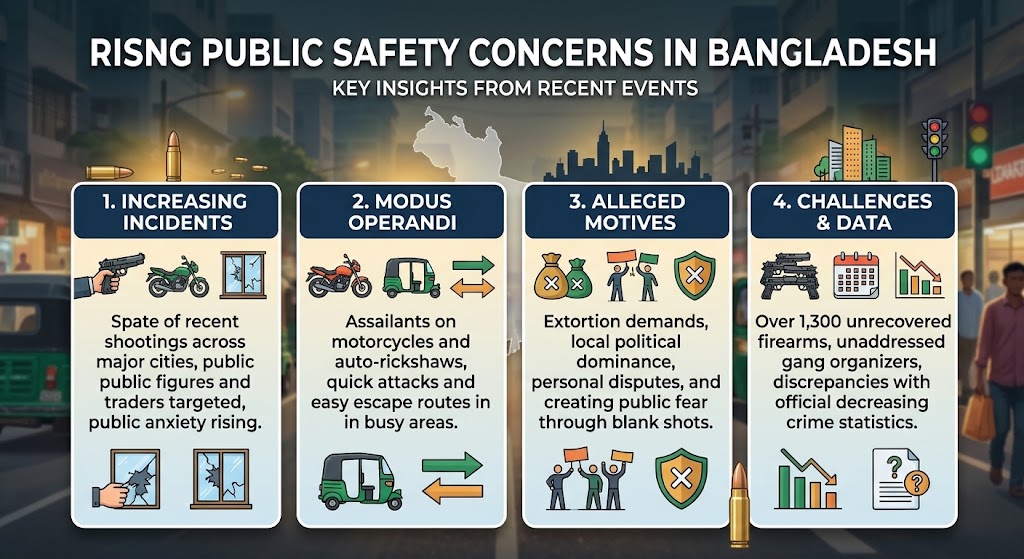
From busy streets in the capital to shops, residential neighbourhoods and medical facilities in district towns, a series of shooting incidents has raised fresh concerns about public safety in Bangladesh. Armed assailants are arriving on motorcycles or in CNG-run auto-rickshaws, opening fire and fleeing the scene. While some attacks are linked by allegations to extortion, attempts to establish local dominance or personal disputes, the motives behind others remain unclear.
The incidents have heightened public anxiety despite government figures indicating a decline in cases involving major crimes.
A shooting targeting the car of singer and former Bangladesh Cricket Board director Asif Akbar in Dhaka’s Moghbazar on October 24 brought the concerns into sharp focus. An unidentified person arrived in a CNG-run auto-rickshaw, got out near the vehicle parked in front of Bishal Centre, fired at the rear-door window and fled. Asif was in his office on the building’s third floor at the time. No one was injured because nobody was inside the car. Police recovered bullet-related evidence from the vehicle.
Asif filed a case against unidentified assailants at Hatirjheel Police Station that night. Police collected CCTV footage and began efforts to identify the attacker, but no significant breakthrough had been reported by the following afternoon. Investigators had yet to establish why the car was targeted or whether the shooting was intended as an attack on the singer or served another purpose.
Other recent incidents in Dhaka have also raised concerns. On October 15, vegetable trader Sumon Ali was shot in front of his business in the Mahirgola area of Basila, Mohammadpur. His son Fahim was injured in the same attack after being hacked. Family members alleged that they had been targeted for disclosing the names of people involved in an earlier murder in Keraniganj. A dispute over setting up roadside shops and collecting money was also cited as a possible motive. Police, however, had not confirmed the actual reason for the attack.
Earlier, on September 12, allegations of extortion emerged after driver Rana was shot inside a house in Moynarbagh, Badda, after assailants entered the premises.
The events of October 24 in Khulna highlighted the challenge of translating tough rhetoric on crime into security on the ground.
That day, Inspector General of Police Ali Hossain Fakir spoke at a community policing gathering in Khulna, pledging a firm stance against terrorism and extortion. On the same day, local Jubo Dal leader Ramim Biswas was shot and injured in Terokhada upazila. He was sitting in a van on the Sen-er Bazar–Madhupur road when assailants on a motorcycle opened fire, hitting him in the ribs.
That evening, grocery shopkeeper Dhananjay Kundu, also known as Akash Kundu, was shot in the abdomen while sitting at his shop in South Tutpara, Khulna city. Police initially suspected that intimidation or extortion might have been linked to the incident, although the theory had not been confirmed through investigation.
At around 9:15pm, a group of assailants fired blank shots outside Sandhani Clinic on Babukhan Road before entering the premises and vandalising property.
Three attacks in different locations of the same district on the day of the police chief’s tough message raised questions about the gap between official assurances and the security experienced by residents.
Khulna had witnessed other shootings in recent weeks. On October 10, armed assailants arriving on a motorcycle shot Asaduzzaman Jony as he stood in front of his house on Kashem Road. Police said the following day that CCTV footage had helped identify suspects, but they had not yet been arrested. On October 4, Nasimul Karim was shot dead while sitting at a tea stall in Dighalia.
It remains unclear whether these incidents share any links involving weapons, the suspects’ networks or criminal motives. Such connections cannot be established without separate investigations and supporting evidence.
The threat is not confined to clashes between rival groups seeking control over an area. Shopkeepers, people standing outside their homes, patients at medical facilities and pedestrians can also find themselves exposed to gunfire.
Alongside targeted attacks, there have been incidents in which assailants fired blank shots apparently to create fear. The consequences extend beyond the number of people killed or injured. Such violence can disrupt local businesses, restrict normal movement and discourage people from speaking out against criminal activities.
Assessing the risks also requires a clearer understanding of where shootings occur and what drives them. Without separate data on the nature, location and motives of these incidents, it is difficult to identify high-risk areas or determine whether particular forms of violence are increasing.
Similar incidents have occurred outside Khulna. In Sitakunda, Chattogram, Jubo Dal activist Tarek Hossain Bappy was shot dead after being assaulted late on October 16. Another Jubo Dal activist, Tafsir Alam Shawon, was also shot and injured in the same incident. Published reports said CCTV footage showed several people being beaten before assailants opened fire and fled.
Although some victims or suspects have political affiliations, that alone does not establish the motive behind an attack. The circumstances of each case must be investigated individually.
Government statistics present a different picture. According to figures released by the Home Ministry, the number of cases involving seven categories of crime fell to 17,335 between January and September this year, from 18,661 during the same period in 2025.
Murder cases declined from 2,913 to 2,659, while robbery cases fell from 538 to 387.
The government views the figures as evidence of an improvement in the law-and-order situation. However, the available statistics do not provide a separate comparative picture of all shooting incidents, the display or use of firearms, or extortion-related violence.
There is also insufficient evidence to determine when Bangladesh last experienced a similar pattern of shootings. Analysts caution that describing the current period as the worst on record would be premature without comparing data across multiple years on shootings, weapons used, casualties and the outcomes of investigations.
The availability of illegal weapons is another issue requiring attention.
According to Police Headquarters data, 1,309 firearms looted from police facilities during the unrest surrounding August 5, 2024, had remained unrecovered as of August 26, 2026. A substantial quantity of ammunition was also reported missing.
However, there is no confirmed information establishing whether the looted weapons were used in each of the recent shooting incidents.
Speaking in Khulna, the IGP also referred to alleged links between extortionists and influential individuals. He said an initiative was under way to introduce new legislation that would allow police to file cases on their own initiative based on digital evidence, even when complainants were unwilling to come forward.
Alongside legal changes, effective prevention will require intelligence-led surveillance, prompt investigations, tracing the sources of illegal weapons and ensuring that cases progress through the judicial system.
Additional IGP Saiedur Rahman rejected the claim that the law-and-order situation was deteriorating.
“It is true that criminals possess illegal firearms. At the same time, police are regularly conducting operations to recover illegal weapons and arrest offenders,” he said. He added that isolated shooting incidents occurred in other countries as well and should not, by themselves, be treated as proof of a deterioration in law and order.
Crime analyst Dr Touhidul Haque offered a different assessment. The associate professor at the University of Dhaka’s Institute of Social Welfare and Research said criminal groups were increasingly becoming divided and involved in conflicts over political dominance, extortion, land and property grabbing, and drug trafficking.
“We are observing with grave concern that divisions and conflicts are emerging among criminal groups in different parts of the country over political dominance, extortion, illegal occupation and drug trading. One group is attacking another, opening fire and, in some cases, committing murder,” he said.
Haque acknowledged that law enforcement agencies had recently arrested many suspects in high-profile cases and other reported crimes. However, he argued that many people arrested in extortion cases were lower-level offenders.
Unless the principal organisers, those issuing instructions and their patrons were brought to justice, he said, arresting people operating at the ground level alone would not produce lasting change.
He also stressed that party discipline and enforcement of the law must work together, regardless of an accused person’s political affiliation. Action against major offenders, he warned, should not be lenient, symbolic or reduced to compromise.
In many cases, police arrive after the gunfire has stopped, collect evidence and register a case. The central question remains how armed assailants are able to obtain weapons, identify targets, reach public places and escape so quickly.
Reducing such incidents will require more than arrests after attacks. Authorities need to trace illegal weapons, strengthen intelligence gathering, accelerate investigations and monitor whether suspects are repeatedly involved in criminal activity. Transparent data on shootings, arrests, prosecutions and convictions would also help establish whether public safety is improving.
Official crime statistics and citizens’ experiences of safety both matter when assessing law and order. A decline in reported cases may be encouraging, but it will not allay public fear unless authorities can also prevent armed attacks in public places and bring those responsible to justice.
The challenge is not only to investigate shootings after they occur, but also to explain how armed assailants continue to reach their targets and flee with apparent ease—and to prevent them from doing so again.
What do you feel about this post?

Like

Love

Happy

Haha

Sad