

International Desk:
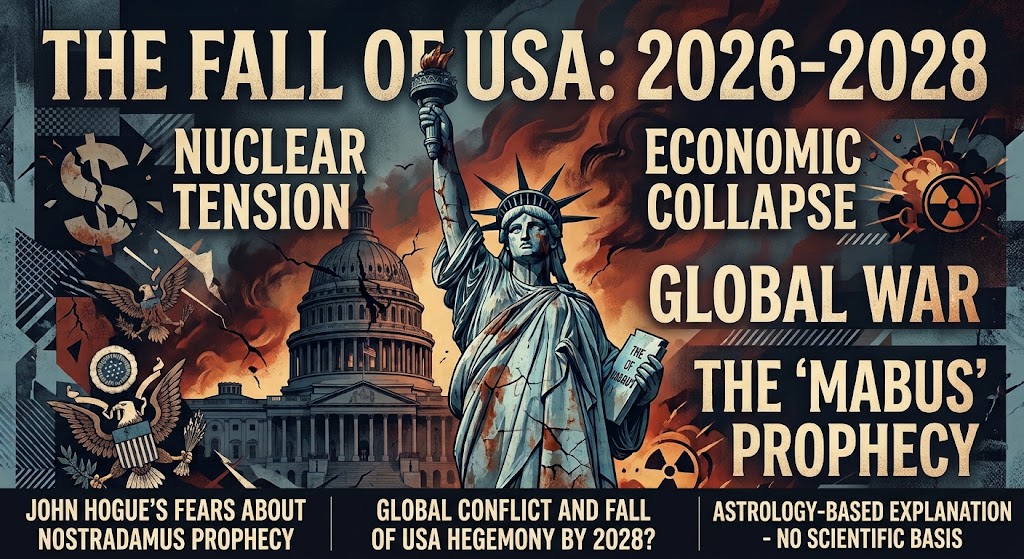
Predictions of nuclear attacks, a prolonged global war and the possible decline of the United States by 2028 have drawn attention following claims by John Hogue, a self-described interpreter of the prophecies of 16th-century French astrologer Nostradamus. However, the alarming scenarios remain speculative and are not supported by reliable scientific evidence.
Hogue, who is often described as “America’s Nostradamus,” claims to have spent nearly four decades studying ancient prophecies. In a report published by British tabloid The Sun, he reportedly outlined a series of possible global crises, including a nuclear confrontation involving Iran, escalating tensions between Russia and NATO, and a major shift in the international balance of power.
His interpretations link cryptic passages attributed to Nostradamus with contemporary geopolitical developments. However, there is no independently verified evidence that these writings predict specific events or establish a credible timeline for the disasters Hogue describes.
Hogue has warned that a military confrontation involving Iran could escalate beyond the use of conventional weapons. He argues that a prolonged conflict, combined with declining stocks of conventional weapons among Western countries, could increase the risk of tactical or strategic nuclear weapons being used.
He has identified Iran’s underground nuclear facilities as potential flashpoints, suggesting that attacks on such sites could trigger retaliatory strikes and widen the conflict.
Hogue has also raised the possibility of US warships in the Arabian Sea coming under attack from Iranian missiles and North Korean drones. In his scenario, such attacks could cause severe damage to American naval assets and result in substantial casualties among US sailors and Marines.
He warns that these developments could place the world under the threat of a nuclear catastrophe by 2028.
However, these claims are speculative. No reliable evidence establishes that such attacks will occur within the timeframe he has suggested.
Another central element of Hogue’s interpretation is a mysterious figure called “Mabus,” mentioned in discussions of Nostradamus’s alleged prophecies.
According to Hogue, the death or assassination of this figure could trigger a devastating war lasting 27 years.
He has linked the name “Mabus” to the initials MBS, commonly used to refer to Saudi Crown Prince Mohammed bin Salman. Based on this interpretation, Hogue has suggested that an unexpected death, a palace coup or an aircraft explosion involving the Saudi leadership could potentially trigger a wider conflict.
There is, however, no credible evidence that Nostradamus’s reference to “Mabus” identifies Mohammed bin Salman. The proposed connection is Hogue’s personal interpretation, not an established historical or factual conclusion.
Hogue further warns that a major conflict in the Middle East could devastate the region’s oil, natural gas and helium industries. Disruptions to energy infrastructure, pipelines and international supply networks could have far-reaching consequences for global energy markets and food and water security.
Hogue has also expressed concern about the possibility of a wider confrontation between Russia and NATO.
He argues that deeper direct involvement by European countries in the war in Ukraine could prompt Moscow to target European weapons manufacturing facilities with hypersonic missiles.
According to his scenario, retaliatory military action could increase the risk of tactical nuclear weapons being used, potentially transforming a regional conflict into a much broader war.
His prediction of a 27-year global conflict is among the most dramatic elements of his interpretation. However, no established evidence supports the claim that such a war will begin or continue for the period he has described.
The possibility of escalation in international conflicts is a legitimate subject of security analysis, but specific predictions about the timing, duration and outcome of a future world war cannot be treated as established facts without credible supporting evidence.
Hogue’s predictions also suggest that the United States could face a severe economic crisis and a decline in global influence by 2028.
He has linked the period from September 2026 to September 2028 to what he calls a 24-month astrological cycle known as “Shofar Silence.”
According to his interpretation, rising energy prices, potential diesel shortages, persistent inflation, political instability and mounting national debt could place significant pressure on the US economy.
Hogue argues that these challenges, combined with the divisive political leadership of President Donald Trump, could weaken Washington’s international standing.
He has also singled out September 11, 2028—the anniversary of the 2001 terrorist attacks in the United States—as a symbolic date for what he predicts could be a major turning point in American global dominance.
However, the economic outlook of the United States depends on a wide range of measurable factors, including productivity, employment, monetary policy, government borrowing, international trade and political decisions. Astrological interpretations do not provide a reliable basis for predicting the collapse of a major economy on a specific date.
Hogue has said that his intention is not to frighten people but to warn them about potential dangers and encourage a preference for peace over violence.
Nevertheless, interpretations of Nostradamus’s writings have long been controversial. Many of his verses are cryptic and open to multiple readings, allowing later interpreters to connect them with contemporary political developments and anticipated future events.
Hogue’s claims should be understood in that context. His warnings about nuclear attacks, a 27-year world war and the decline of the United States have not been established as reliable predictions.
Military tensions, nuclear proliferation and economic uncertainty remain genuine international concerns. Assessing these risks, however, requires verifiable intelligence, economic indicators, credible research and evidence-based security analysis.
Until such evidence is available, Hogue’s predictions should be treated as speculative interpretations rather than confirmed forecasts of events expected to occur by 2028.
What do you feel about this post?

Like

Love

Happy

Haha

Sad