Tanvir Raihan:
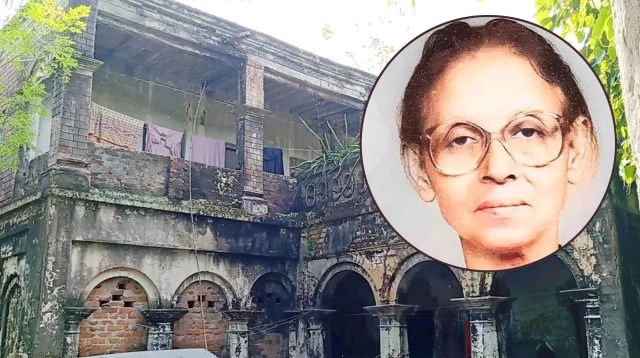
The ancestral home of Ila Mitra, the legendary leader of the Nachole peasant uprising, remains under occupation and is gradually falling into ruin. Nearly a decade after the government gazetted the property for preservation as an archaeological heritage site, the acquisition of the house and its land remains incomplete.
Cracks have appeared in the walls, sections of the roof have collapsed, and the historic building is deteriorating due to a lack of maintenance. Once known for its architectural details, the property is now at risk of losing much of its historical character.
Located in Bagutia village under Nityanandapur Union of Shailkupa upazila in Jhenaidah, the house is at the centre of a long-standing dispute over preservation and occupation. Current residents say they are willing to leave if arrangements are made for their rehabilitation. Local administration officials, however, say they have received no specific instructions regarding land acquisition, adding that preservation of the property falls under the Department of Archaeology.
Local heritage activists allege that administrative inaction has delayed effective measures to protect the historic site.
A heritage site left to decay
Ila Mitra’s grandfather, Rajmohan Sen, built the house in 1899. The complex consists of two buildings, one two-storey and the other single-storey, constructed with lime and mortar. Together, they contain nine rooms and a main entrance gate.
Located about 13 kilometres from Shailkupa upazila town, the property was once a prominent ancestral residence. After members of the family left the country, the house reportedly passed into other hands. A substantial amount of land left by Ila Mitra’s father, Nagendranath Sen, is also said to have been lost to the family.
The house was included on a list of archaeological heritage properties in 2014. In 2017, the house and 22 decimals of land were declared a protected archaeological site. The Ministry of Cultural Affairs published a gazette notification on January 4 that year and issued instructions to the local administration to take necessary measures.
However, despite the passage of nearly a decade since the notification, no significant progress has been made in completing the acquisition and preservation process.
Residents willing to leave if rehabilitated
According to current residents, a man named Khodabux purchased the property before it passed to Haji Qiam Uddin. They claim that descendants of Qiam Uddin have been living there since 1970.
A visit to the site revealed extensive damage. A large section of the roof has collapsed, the walls are cracked, and rubbish has accumulated around the buildings.
Four sons of Haji Qiam Uddin—Ali Hossain, Jahangir Alam, Abdur Rashid and Rashidul Islam—currently live in the dilapidated structures.
Some of the residents said they were prepared to leave if the authorities arranged alternative accommodation for them.
“If arrangements are made for our rehabilitation, we will leave. Every year, you come here and disturb and harass us. Please do not come here anymore,” they said.
Their remarks highlight the challenge facing the authorities: preserving the historic property while addressing the concerns of those currently living there.
From an ancestral home to a symbol of peasant resistance
Ila Mitra was born in Kolkata. Her father, Nagendranath Sen, served as a deputy accountant general in Bengal, while her mother, Manorama Sen, was a homemaker.
Her ancestral home was in Bagutia village, where she visited several times during her childhood. She also had childhood and adolescent connections with nearby villages, including Gopalpur, Shekhra, Raghunandanpur and Shahabazpur.
She studied at Bethune School and the University of Calcutta, earning a postgraduate degree in Bengali literature and culture. She later taught at Calcutta City College and retired in 1989.
Between 1946 and 1950, Ila Mitra emerged as a leading figure in the peasant movement in Nachole, then part of Rajshahi district in East Pakistan.
She helped organise landless labourers, sharecroppers, Santal and other Indigenous communities, and impoverished farmers in a movement demanding the abolition of the zamindari system and a fairer share of agricultural produce.
Her involvement in the movement led to her arrest and torture in custody. She later gave a historic deposition in court describing the torture she had endured.
Mitra remained imprisoned in Rajshahi Jail until 1954. She was subsequently released on parole and travelled to Kolkata for medical treatment. After being sentenced to life imprisonment in a case related to the killing of police personnel during the Nachole uprising, she could not return to what was then East Pakistan.
She continued her political, social and cultural activities in India.
Between 1962 and 1978, she was elected to the West Bengal Legislative Assembly four times. She served as deputy leader of the Communist Party in the assembly in 1967 and 1972. She was also elected several times to the Senate of the University of Calcutta as a teachers’ representative.
Alongside her work on women’s rights, education and cultural movements, she helped mobilise public support in India for Bangladesh’s Liberation War in 1971.
Mitra was also an accomplished athlete. She won the state junior athletics championship from 1935 to 1938 and was skilled in basketball and badminton. She was selected to participate in the 1940 Helsinki Olympics, but the Games were cancelled because of the Second World War.
Two decades of preservation efforts
Organised efforts to preserve Ila Mitra’s ancestral home began in 2011. Activists staged human chains and protest marches in Jhenaidah, Shailkupa and Dhaka and submitted memorandums to various government offices.
Although the house was subsequently listed and gazetted as an archaeological heritage site, preservation work has yet to make meaningful progress.
Abdur Rahman Milton, convener of the Ila Mitra Smriti Sangrakkhan Parishad, said they had been campaigning to protect the property for nearly 25 years.
“We have been campaigning to preserve Ila Mitra’s ancestral home for nearly two and a half decades, but the house has still not been preserved. The process has stalled because of weaknesses and negligence on the part of the local administration. Even after so many years since the gazette notification, no signboard has been installed at the site,” he said.
He added that the building’s architectural features and beauty had deteriorated, leaving it close to becoming a ruin.
Sujan Biplab, convener of the Comrade Ila Mitra Birth Centenary Celebration Council, said ownership of the property remained disputed.
He alleged that after the Partition of India, members of Ila Mitra’s family settled in Kolkata, and the house and land subsequently passed out of their hands. The current residents claim ownership based on various deeds, he said.
Biplab also questioned the process through which a deed was registered in 1970.
“Considering the historical significance of the ancestral home of Ila Mitra, the leader of the Nachole uprising, the government must immediately take steps to remove the occupation and preserve the property,” he said.
He further alleged that visitors were sometimes verbally abused and prevented from entering the premises.
Abu Towab Apu, general secretary of the Jhenaidah district committee of the Communist Party of Bangladesh (CPB), said that although photographs of Ila Mitra could be found in various government offices, little effective action had been taken to preserve her legacy.
He called for a research centre or archive at the ancestral home to document her political life, the peasant movement and her contribution to social change.
“Although the house has been declared an archaeological site, we still cannot visit it freely to pay our respects. Preserving her ancestral residence is essential to presenting her political life and the history of the peasant movement to future generations,” he said.
Jhenaidah cultural activist Sharmin Zoarddar described Ila Mitra as an inspiration for women’s leadership and struggles for social emancipation.
She said the failure to preserve the house risked depriving future generations of an important historical legacy and called for a joint initiative involving the government and local residents.
Authorities promise action
Jhenaidah Deputy Commissioner Md Noman Hossain said the district administration would make every effort to help preserve Ila Mitra’s ancestral home.
He said he would contact the Ministry of Cultural Affairs and other relevant agencies to explore the necessary steps.
Asked why no local programme had been arranged to mark Ila Mitra’s birth centenary, the deputy commissioner said the district administration had not issued any such directive. He added that he would discuss the matter with the upazila nirbahi officer.
Shailkupa Upazila Nirbahi Officer Mahfuzur Rahman said the Department of Archaeology was responsible for the property following its declaration as an archaeological heritage site.
He said he was unaware of what steps the department had taken regarding land acquisition and preservation.
Mohidul Islam, regional director of the Department of Archaeology for the Khulna division, acknowledged that the house had not been adequately preserved despite the 2017 gazette notification.
He said the department regularly monitored the property and had plans to renovate it. The department hoped to receive funding in the next fiscal year, he added.
“There is also a problem of occupation at the property. We are maintaining communication with the administration to resolve these issues. Steps will be taken soon to preserve and renovate Ila Mitra’s ancestral home,” he said.
A race against time
Ila Mitra died on October 13, 2002. Yet her ancestral home remains without adequate protection, despite years of campaigning, a government gazette notification and repeated assurances from the relevant authorities.
The lack of progress has fuelled frustration among local activists and cultural figures, who fear that the historic structure may disappear before its significance can be properly documented and presented to future generations.
Unless the authorities complete the land acquisition process, address the rehabilitation of current residents and undertake urgent restoration work, the property could be lost altogether.
Such a loss would mean more than the disappearance of an old house. It would also diminish an important opportunity to preserve the memory of Ila Mitra and the peasant struggle with which her name remains closely associated.
What do you feel about this post?

Like

Love

Happy

Haha

Sad