

Staff Reporter:
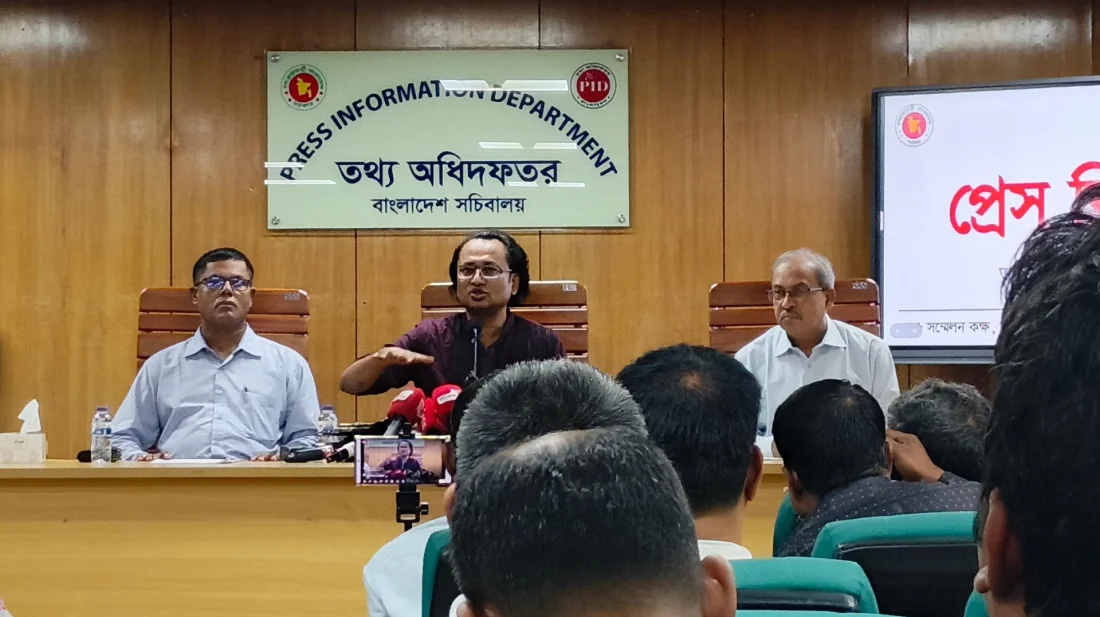
Information and Broadcasting Adviser to the Prime Minister Dr Zahed Ur Rahman has ruled out any scope for extrajudicial killings, saying that the state must uphold the law and ensure justice through judicial procedures rather than resorting to unlawful force.
“A state becomes a state when it exercises the power to deliver justice. When the state apprehends someone and kills them without trial, it ceases to function as a state and behaves like a thug,” he said.
He made the remarks while responding to questions from journalists at the government’s weekly briefing on the progress of various activities, held at the conference room of the Directorate of Information on Tuesday (October 27).
His comments came amid public debate over alleged extremist activities, attacks on minority communities, obstruction of a freedom fighter’s burial, political violence and recent remarks by Inspector General of Police (IGP) Md Ali Hossain Fakir concerning “crossfire”.
The adviser said the government was not remaining silent over extremist activities and the actions of groups involved in violence. Legal action was being taken against those responsible, and the government would maintain a firm position against such activities, he added.
Responding to questions about the IGP’s controversial comments on “crossfire”, Zahed Ur Rahman said the Police Headquarters had already issued an explanation following the public debate.
He acknowledged that the IGP’s original remarks could reasonably have been interpreted as suggesting the possibility of extrajudicial killings, adding that many people had understood them that way.
However, the subsequent clarification from Police Headquarters stated that the IGP had not intended to advocate extrajudicial killings, the adviser said.
He also noted that the police authorities had clarified the IGP’s comments concerning journalists, which had been criticised as making a sweeping allegation against members of the media.
“When a person holding a responsible position makes a statement that is misunderstood by the public, it is necessary to clarify it. He has provided an explanation, and I think that has helped make the matter clear,” the adviser said.
Asked whether clarification alone was sufficient or whether administrative action would be taken against the IGP, he did not announce any immediate decision.
He said the matter could be considered by the Prime Minister after completing an important overseas visit, if the government deemed further action necessary.
Explaining the government’s position on extrajudicial killings, Zahed Ur Rahman said a democratic state could not use executive power to kill anyone outside the law.
The state’s responsibility, he said, was to arrest suspects, investigate alleged offences and bring those accused before a court for trial.
He pointed out that although Bangladeshi law provides for the death penalty, it can only be imposed after the required judicial procedures have been completed.
“There is no scope for imposing the death penalty by bypassing the law and the courts,” he said.
The adviser argued that if a government carried out extrajudicial killings, the distinction between the state and an ordinary criminal would be undermined.
He also rejected the suggestion that police could lawfully conduct “crossfire” operations if authorised by the government, stressing that executive approval could not make an illegal act lawful.
Public officials and employees of the Republic, he said, were not obliged to carry out unlawful orders and must operate within the boundaries of the law.
“Even if they are instructed to do something illegal, public servants are not required to comply. They must act within the law,” he said.
Reassuring the public that an elected government would not pursue extrajudicial killings, the adviser said such actions could provoke serious negative reactions among citizens and ultimately harm the government itself.
During the briefing, he also responded to questions concerning a Washington-based press conference by Sheikh Hasina, efforts to bring her back to Bangladesh, recent communal and political violence, recommendations of the Media Reform Commission, constitutional amendments, the Right to Information Act and ongoing government activities across different ministries.
The adviser reiterated that law enforcement and the administration must operate within the legal framework, maintaining that criminal offences must be addressed through investigation, prosecution and judicial proceedings rather than killings outside the law.
What do you feel about this post?

Like

Love

Happy

Haha

Sad