
Staff Reporter:
Home Minister Salahuddin Ahmed has said that modern, integrated and technology-driven border management plays an essential role in achieving the country’s economic growth and strengthening national security.
He said Bangladesh is now more connected with the outside world than ever before. Against this backdrop, the government is working continuously to develop a technology-based immigration system that meets international standards, facilitates international travel and trade, and addresses cross-border risks.
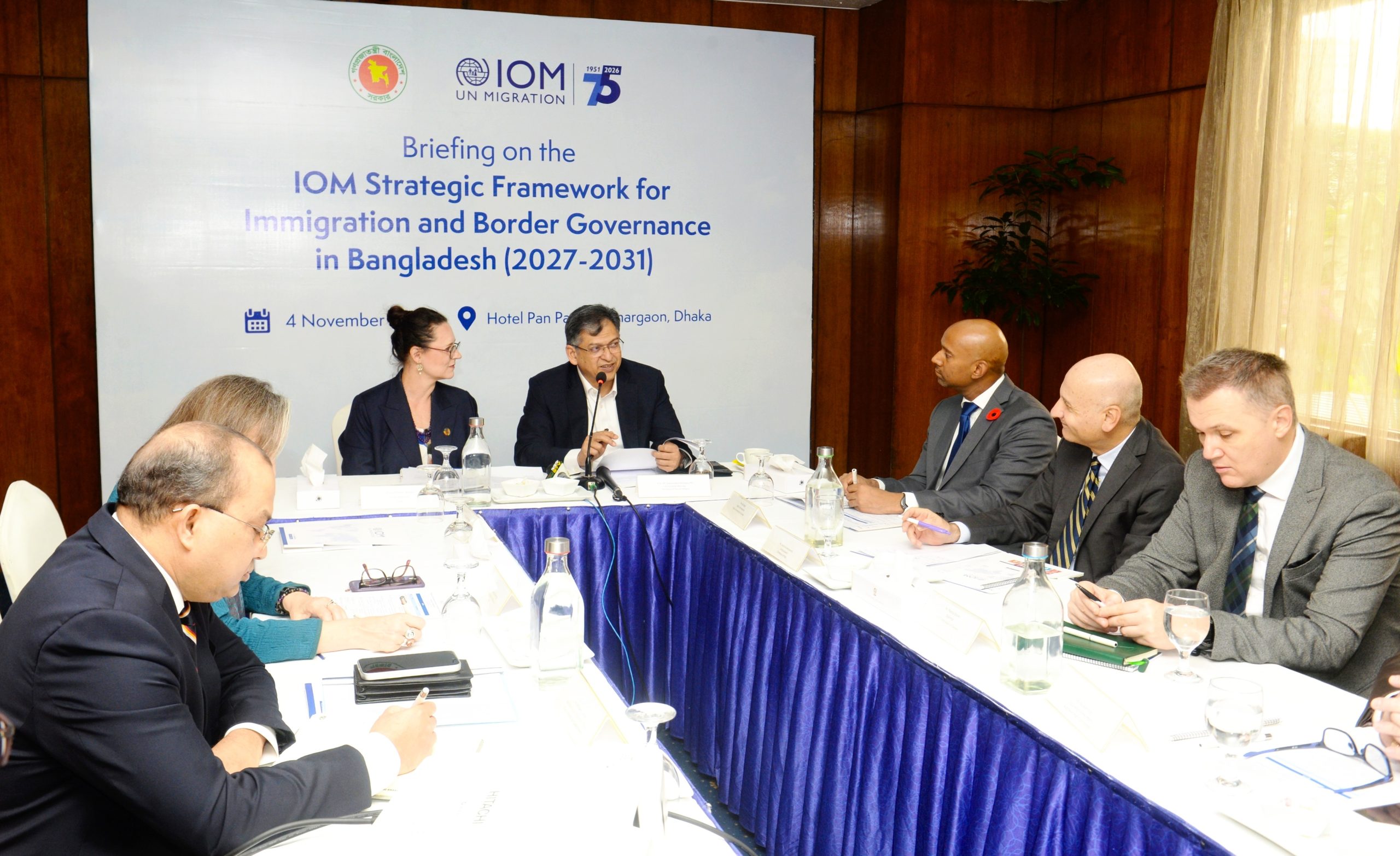
The minister made the remarks as the chief guest at a briefing titled “IOM Strategic Framework for Immigration and Border Governance in Bangladesh (2027–2031)”, organised by the International Organization for Migration (IOM) at the Meghna Hall of Hotel Pan Pacific Sonargaon in Dhaka on Wednesday.
The minister said border management must ensure national security while facilitating legitimate travel and trade. Referring to the government’s National Integrated Border Management Strategy 2026–2031 and the Five-Year Strategic Framework for Reform and Development 2026–2031, he said digital transformation, the responsible use of artificial intelligence (AI), paperless administrative operations and greater interoperability among government services were among the government’s key priorities.
Highlighting the important role of the Special Branch (SB) of Bangladesh Police in immigration management, Salahuddin Ahmed said the operational capacity of airports, land ports and immigration checkpoints needed to be enhanced significantly through a combination of policy measures and modern technology.
At the same time, he stressed that border management should not be limited to technological solutions but should also be sensitive to human rights and protection standards and uphold professionalism.
Emphasising inter-ministerial coordination to prevent transnational crime, human trafficking and irregular migration, the home minister said border management was not the responsibility of any single agency. It required joint efforts by all relevant ministries, departments and law enforcement agencies.
The minister welcomed the IOM’s proposed strategic framework for 2027–2031 and called on the organisation to continue supporting the development of an internationally recognised border management system in Bangladesh.
He also urged development partners to increase technical and financial assistance, saying international investment would not only help secure Bangladesh’s borders but also make a significant contribution to regional stability and safe globalisation.
Speaking at the briefing, IOM Bangladesh Chief of Mission Dr Laura Tomm Bonde said Bangladesh had already made significant progress in strengthening its immigration and border management capacity.
“As travel patterns and operational requirements evolve, the need for effective systems, skilled personnel and better coordination among relevant agencies will continue to grow. Through technical expertise and partnerships, IOM is keen to support the government in implementing its priorities,” she said.
Additional Secretary of the Political and External Affairs Division of the Ministry of Home Affairs Dr Ziauddin Ahmed, Joint Secretary of the Political-1 Wing Rebecca Khan, Additional Inspector General of Police of the Special Branch Md Kamrul Ahsan and Deputy Inspector General of Police Md Moazzem Hossain attended the programme.
Canadian High Commissioner to Bangladesh Ajit Singh and Italian Ambassador Antonio Alessandro, along with representatives of various partner organisations, also took part in the discussion.
Participants exchanged views on ways to facilitate legitimate travel and trade while addressing challenges such as human trafficking, cross-border crime and identity fraud.
The proposed strategic framework has identified four potential areas of cooperation: integrated border management; digital systems and information sharing; institutional and professional capacity development; and infrastructure and service improvements at selected border points.
The framework has also taken into consideration the government’s Five-Year Strategic Framework for Reform and Development covering July 2026 to June 2031.
What do you feel about this post?

Like

Love

Happy

Haha

Sad