Editorial:
Every year, after the publication of Higher Secondary Certificate (HSC) examination results, discussions revolve around pass rates, GPA-5 achievers and the number of students who fail. Some blame students for their lack of attention, others point to teachers, while many highlight the lack of awareness among parents. But following this year’s disappointing results, a more fundamental question needs to be asked: Is our education system actually enabling students to learn, or is it merely teaching them how to pass examinations?
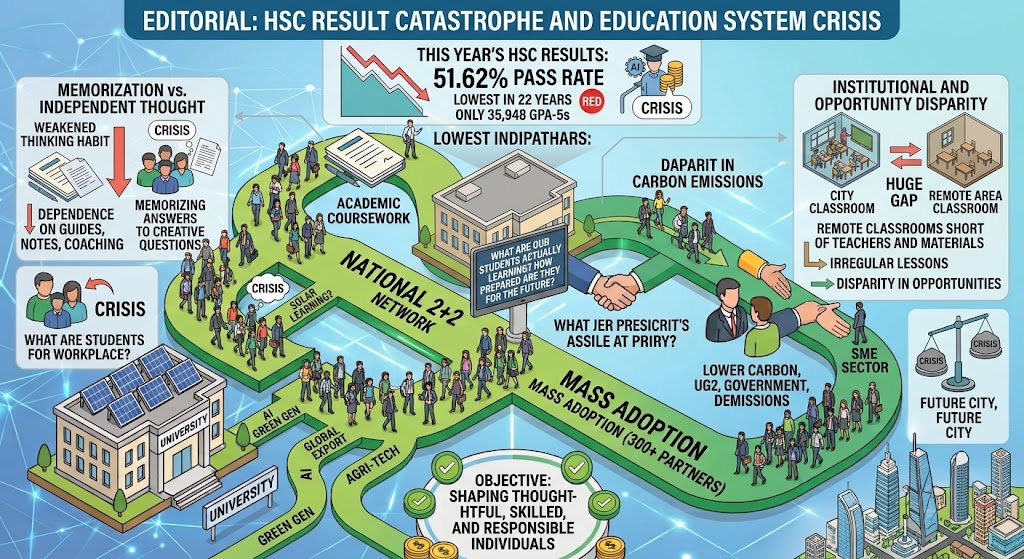
This year’s HSC pass rate stood at 51.62 per cent, the lowest in 22 years. Of the 1,048,530 candidates who appeared for the examinations, only 35,948 secured GPA-5. In 2021, the pass rate was nearly 95 per cent. Such a dramatic fluctuation within a few years is certainly alarming. However, viewing the decline in results as the entire problem would be a mistake. Instead, the outcome offers an opportunity to examine the deeper weaknesses within our education system.
The success of an education system cannot be measured solely by how many students pass examinations. It must also be assessed by how well they understand what they study, explain concepts in their own words and apply their knowledge to real-life situations. Yet, in our education system, examination scores have become the primary measure of intelligence and merit.
One of the most damaging consequences of this culture is the weakening of students’ ability to think independently. Instead of understanding textbooks, many rely heavily on guidebooks, notes, question banks and coaching centres. Their main concern is predicting likely questions and memorising answers that will secure good marks. As a result, many struggle when questions are presented in an unfamiliar format. Even after the introduction of the creative question system, this dependence on memorisation has not disappeared. In many cases, students have simply started memorising model answers to creative questions.
Students cannot be held solely responsible for this situation. In a system where parents depend on coaching centres to ensure good results, teachers face pressure to complete prescribed syllabuses and institutions are judged primarily by examination performance, expecting students to develop independent thinking and creativity becomes difficult. The problem, therefore, is far more institutional than individual.
Another major challenge is inequality in access to quality education. There is a significant gap between well-established institutions in urban areas, with adequate teachers and learning facilities, and many institutions in remote regions. Some schools face teacher shortages, others lack sufficient classrooms and educational materials, while regular classroom activities are disrupted in some places. Although all students may sit for the same examinations, their opportunities to learn are not necessarily equal. Therefore, an assessment of examination results should also consider regional disparities, institution-wise performance, subject-specific outcomes and teacher availability.
Meanwhile, the world is changing rapidly. Artificial intelligence, automation and technological advancement are continuously reshaping the job market. In such circumstances, rote learning alone cannot prepare students for the future. They need analytical thinking, problem-solving, communication, teamwork, digital skills and the ability to make ethical decisions. These competencies cannot be adequately measured through a few predetermined answers in an examination script.
A reform of the assessment system is therefore essential. Alongside final examinations, greater emphasis should be placed on continuous assessment, practical assignments, project-based learning, oral presentations and real-world problem-solving. However, introducing new methods without ensuring proper teacher training, adequate staffing, necessary infrastructure and reliable assessment mechanisms will achieve little. Otherwise, reforms will merely change the examination structure without improving the quality of education.
Most importantly, education reform must be kept above political changes. Frequent alterations to curricula and assessment methods whenever governments change create uncertainty among students, teachers and parents. Education is a long-term national investment. Its direction must be determined through research, experience and future needs. A permanent national framework involving educationists, teachers, researchers, economists, technology experts and policymakers could help ensure continuity and accountability.
The HSC results crisis should not be viewed merely as a record of students’ failures. It is an opportunity to reassess the education system itself. The primary objective of education is not simply to help students pass examinations, but to develop them into thoughtful, skilled and responsible individuals.
Unless we fulfil that objective, even an increase in pass rates will not represent genuine progress. The question is no longer simply how many students have passed, but what they are actually learning and how well they are being prepared for the future.
What do you feel about this post?

Like

Love

Happy

Haha

Sad