

Teknaf (Cox’s Bazar) Reporter:
For Rohingya refugees living in camps in Cox’s Bazar, the International Court of Justice (ICJ) ruling holding Myanmar responsible for genocide has brought renewed hope after years of waiting for justice. Many have described the decision as a historic step, while stressing that its real significance will depend on whether it leads to accountability and a safe return to their homeland.
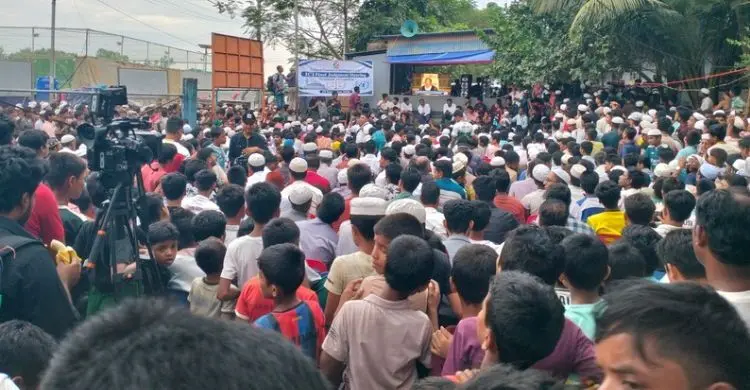
Hundreds of Rohingya gathered in camps on Thursday, November 19, to watch the court proceedings live on large screens. As the ruling was announced in The Hague, the memories of violence in Myanmar’s Rakhine State, lost relatives and forced displacement overwhelmed many viewers, with some breaking down in tears.
Hundreds of thousands of Rohingya fled Myanmar in 2017 following a military crackdown and widespread persecution in Rakhine State. Many took shelter in camps in Ukhiya and Teknaf in Cox’s Bazar. Since arriving in Bangladesh, they have sought justice for killings and other abuses against their community while repeatedly calling for a safe return to their homeland.
The case was filed by The Gambia against Myanmar at the ICJ in 2019, alleging genocide against the Rohingya. In its ruling announced on Thursday, the court held Myanmar responsible for genocide by a 9-6 vote. The judgment also addressed Myanmar’s failure to meet its obligations to prevent genocide and punish those responsible.
Ali Akbar, a resident of Jamtoli camp, said he had witnessed neighbours being killed during the military crackdown in Rakhine in 2017. He said he had been forced to flee to Bangladesh to save his life and had since been seeking justice for his relatives while hoping to return home.
Watching the ruling brought back painful memories of those he had lost, he said, adding that he broke down in tears.
Another camp resident, Mohammad Yusuf, said he had waited to watch the announcement on a large screen alongside other refugees. Hundreds of Rohingya watched the proceedings together, he said, as people around the world followed the decision.
Yusuf stressed that the announcement alone would not be enough. He called on the international community to maintain pressure on Myanmar to ensure the safe return of Rohingya refugees.
Rohingya leader Syed Ullah said the community had waited a long time for justice and described the ruling as a significant step towards accountability.
But he said implementation was essential, urging the international community to take effective measures and increase pressure on Myanmar to ensure their return.
“We do not want any more excuses from Myanmar. We want to return to our homeland,” he said, expressing hope that the ruling would help clear the way for repatriation.
Mohammad Mizanur Rahman, Refugee Relief and Repatriation Commissioner (RRRC) in Cox’s Bazar, said the ruling would play an important role in establishing the identity and rights of the Rohingya.
He said the judgment provided an international basis to challenge Myanmar’s narrative portraying the Rohingya as outsiders. It could also help facilitate their repatriation, he added.
For the refugees, the ruling represents both a long-awaited step towards justice and a renewed hope of going home. Turning that hope into reality, however, will depend on effective implementation of the judgment, sustained international engagement and guarantees of security and rights in Myanmar.
What do you feel about this post?

Like

Love

Happy

Haha

Sad