

Raihan Ahmed:
The long-standing political alliance between the Bangladesh Nationalist Party (BNP) and Jamaat-e-Islami has given way to an increasingly competitive relationship, with both parties seeking to strengthen their positions in the country’s changing political landscape.
Following the fall of the Awami League government, the two parties have been competing to establish themselves as influential forces in post-transition Bangladesh. However, their political interests and strategies have increasingly diverged, with the BNP now leading the government and Jamaat occupying the position of the main opposition party in parliament.
The rivalry, which initially emerged during the election campaign, has expanded into parliamentary debates, political exchanges, constitutional reform issues and other matters of national importance. Both parties are increasingly questioning each other’s political positions while bringing their past relationship and ideological differences into the debate. This has raised questions about whether the current confrontation will remain a short-term political contest or develop into a long-term rivalry.
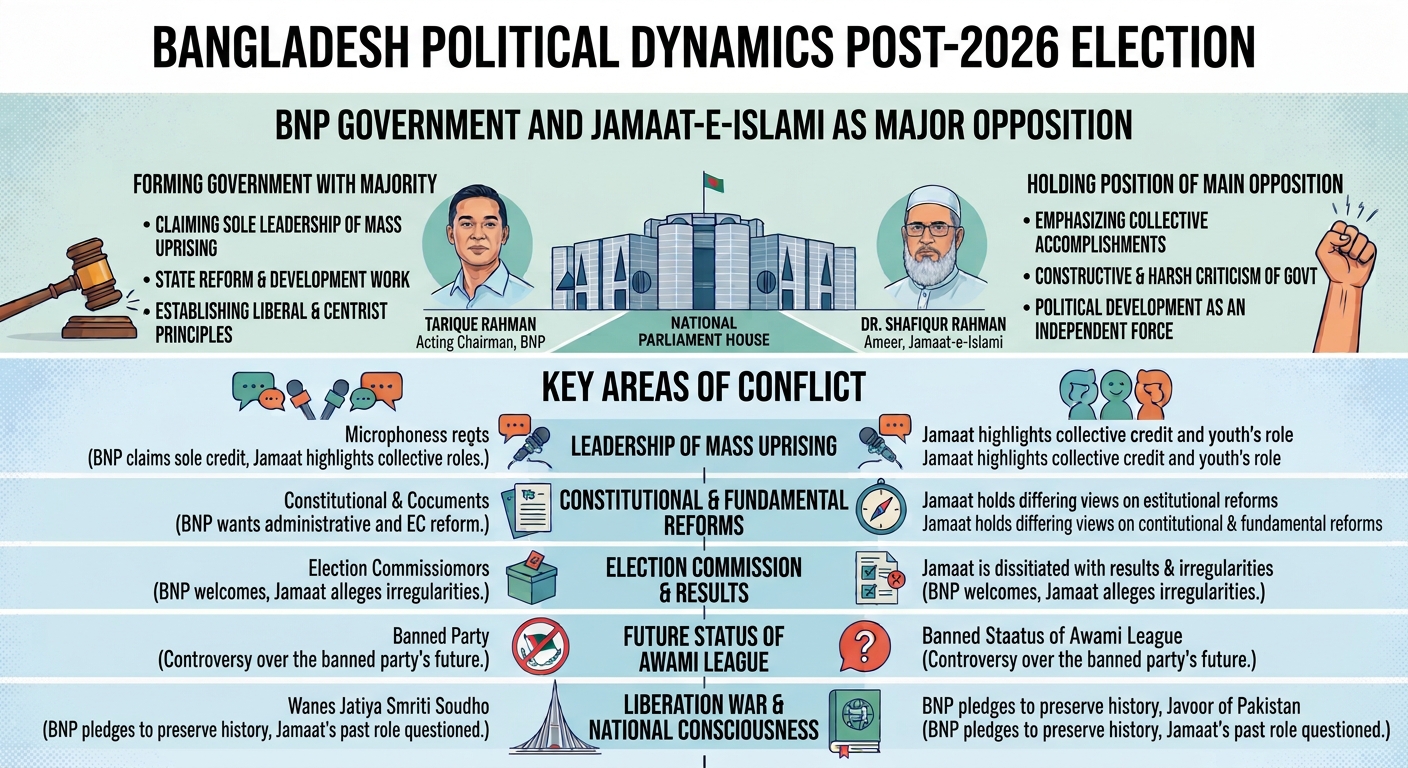
Following the February 12, 2026 general election, the BNP secured a parliamentary majority and formed the government, while Jamaat emerged as the principal opposition force. The change effectively transformed the traditional relationship between the two parties, which had previously worked together through political alliances and joint movements. They are now operating from opposite sides of the parliamentary divide, with different political priorities.
Political observers believe that establishing themselves as the leading forces in the political landscape in the absence of the Awami League has become a major objective for both parties. The BNP is seeking to maintain public support through government performance, while Jamaat is attempting to build an independent political identity by strengthening its organisational network and expanding its role as the opposition.
The rivalry has not remained confined to election campaigns. Differences between the two parties have also become increasingly visible in parliamentary proceedings.
A debate on June 28 over the leadership and achievements of the July uprising highlighted the growing political distance between them. While the BNP highlighted Tarique Rahman’s leadership role in the uprising, Jamaat Ameer Shafiqur Rahman opposed attributing the movement to any single individual, emphasising the collective contribution of the people and young protesters.
The parties also differ over the implementation of the July Charter, constitutional reforms, decisions taken by the interim government and the restructuring of state institutions.
While Jamaat has criticised several government decisions, the BNP believes that misleading and unfounded allegations presented as political criticism could undermine democratic practices and the political environment.
BNP Acting Secretary General Ruhul Kabir Rizvi has expressed dissatisfaction with Jamaat’s approach to its opposition role. He believes that instead of limiting itself to constructive criticism, the party has repeatedly raised exaggerated and baseless allegations against the government.
He has particularly criticised Jamaat’s reaction following the Thakurgaon-1 by-election, viewing its allegations against the Election Commission as an attempt to create controversy over the electoral process.
In the October 29 by-election, BNP candidate Mirza Faisal Amin defeated his Jamaat rival. Jamaat Secretary General Mia Golam Porwar subsequently alleged irregularities involving the election authorities, although the Election Commission expressed satisfaction with the overall voting environment.
The future political position of the Awami League has emerged as another important source of disagreement between the BNP and Jamaat.
The two parties have taken different positions on the political activities of the banned Awami League, the role of its leaders and activists, and allegations of attempts to create instability in the country.
Prime Minister Tarique Rahman has raised questions about the political positions of the Awami League and Jamaat, including their alleged past contacts. At a public rally in Rajshahi on October 20, he alleged that individuals associated with the Awami League were providing financial support to create unrest among workers.
On the same day, Jamaat Secretary General Mia Golam Porwar criticised the government’s position, accusing it of shifting responsibility for its failures and alleged corruption onto opposition parties.
Jamaat has argued that individuals associated with the banned Awami League would find it difficult to carry out sabotage without inaction or cooperation from law enforcement agencies and intelligence organisations. The BNP leadership, meanwhile, has highlighted Jamaat’s past political contacts with the Awami League to question its current political position.
Some political observers believe that maintaining its credibility among voters opposed to the Awami League is also important for the BNP. By raising questions about Jamaat’s past political relationships, the party may seek to strengthen its own position among these voters.
The Liberation War and Jamaat’s role in 1971 have also returned to the centre of the political debate.
The BNP has faced criticism at different times over its past alliance with Jamaat and their joint participation in government. The party is now placing greater emphasis on the history of the Liberation War, independence and national sovereignty as part of its effort to establish a clearer political identity.
In its 2026 election manifesto, the BNP pledged to present an accurate history of the Liberation War, prepare a reliable list of martyrs and preserve the memories and heritage of the independence struggle.
Prime Minister Tarique Rahman has also described the Liberation War as a collective struggle of the people rather than the exclusive property of any particular political party.
Political analysts believe that by taking a clearer position on the Liberation War, the BNP is seeking to reinforce its identity as a liberal and centrist political force while placing Jamaat under renewed scrutiny over its historical role.
Local government elections could become the next major battleground between the two parties.
The elections will provide an opportunity to assess their organisational strength and public support beyond the national parliamentary contest.
The BNP’s performance in government, including development activities, administrative decisions, law and order and the delivery of public services, will be crucial in determining whether it can maintain popular support.
If public dissatisfaction grows over government performance, Jamaat may seek to capitalise on the situation through its opposition role. Conversely, if the BNP succeeds in maintaining public confidence, Jamaat could face greater challenges in expanding its influence as an alternative political force.
Jamaat Assistant Secretary General AHM Hamidur Rahman Azad has rejected the suggestion that the current confrontation between the two parties is merely a political arrangement or tactical exercise.
According to him, disagreements in parliament, political debates and opposition walkouts reflect genuine differences between the parties. He has indicated that Jamaat intends to maintain its criticism of government decisions that it considers contrary to public interests and may adopt an even tougher position in the future.
Writer and researcher Mohiuddin Ahmed, meanwhile, believes that the relationship between the BNP and Jamaat has always been shaped by political interests. Their previous alliance was also based on strategic considerations, while the present confrontation reflects competition for political power. He believes the rivalry could continue until the next general election.
Overall, the relationship between the BNP and Jamaat has moved beyond the alliance-based politics of the past and entered a phase of direct competition for power and public support. Differences over ideology, the history of the Liberation War, parliamentary responsibilities and electoral calculations are widening the gap between the two parties.
How far this rivalry will go will largely depend on the BNP’s performance in government and Jamaat’s ability to expand its public support and consolidate its position as the country’s leading opposition force.
What do you feel about this post?

Like

Love

Happy

Haha

Sad