

Tanvir Raihan:
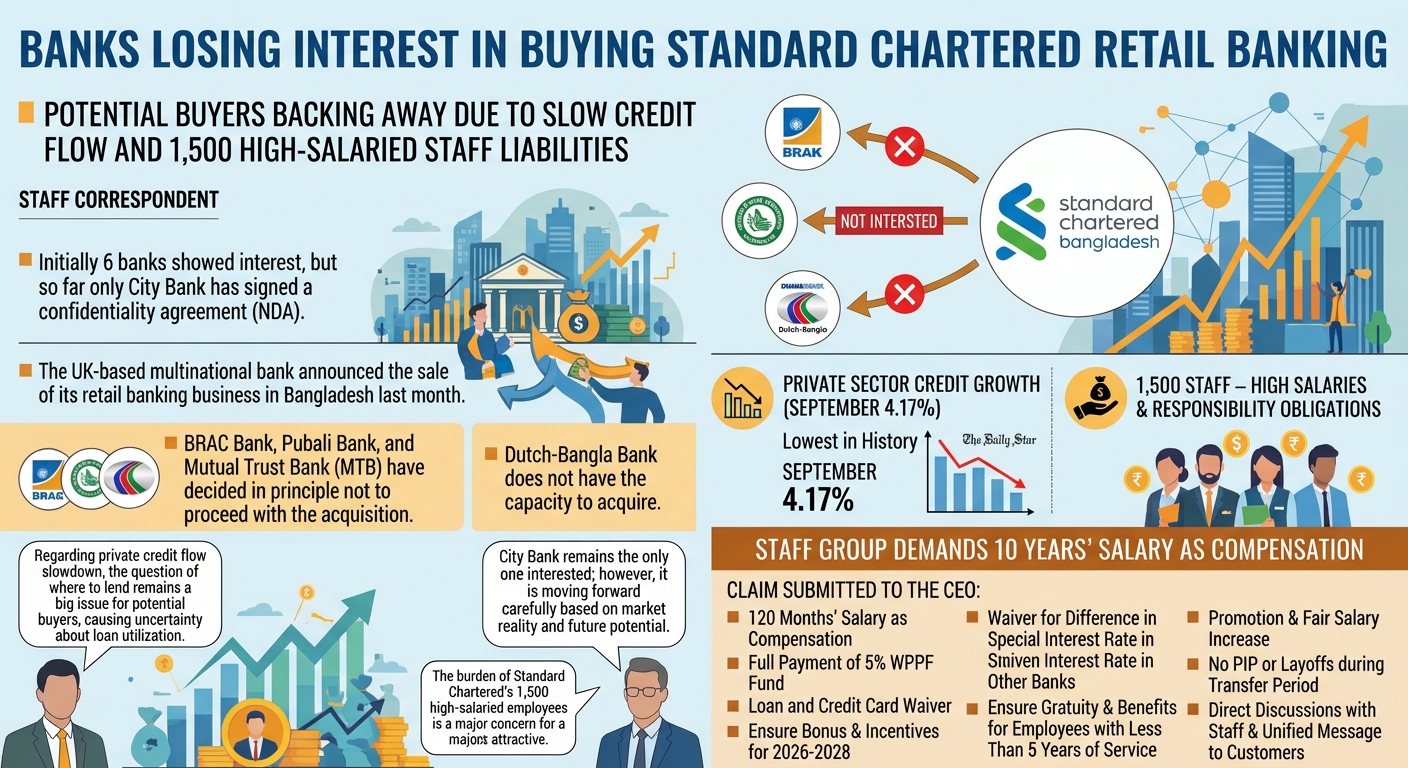
Standard Chartered Bangladesh may face an uphill task in finding a buyer for its wealth and retail banking business, as several local banks that initially expressed interest are now reluctant to proceed with the proposed acquisition.
The slowdown in private-sector lending and the financial burden of absorbing around 1,500 employees with relatively high salaries have emerged as major concerns for potential buyers.
At least six local banks had shown interest in acquiring the business, but City Bank is currently the only institution known to have signed a non-disclosure agreement (NDA) with Standard Chartered Bangladesh.
The banks initially interested in the acquisition were BRAC Bank, City Bank, Pubali Bank, Mutual Trust Bank, Dhaka Bank and Dutch-Bangla Bank.
Officials at BRAC Bank, Pubali Bank and Mutual Trust Bank have told The Daily Star that they have decided in principle not to move forward under the existing terms. Officials at other banks have also questioned whether Dutch-Bangla Bank has the financial and operational capacity to take over the business at this stage.
A key attraction of Standard Chartered’s retail banking portfolio was its substantial base of low-cost deposits. However, the declining demand for private-sector credit has weakened the appeal of acquiring such deposits, as prospective buyers are uncertain about how to deploy the additional funds profitably.
Bangladesh Bank data show that private-sector credit growth fell to 4.17 per cent in September from 4.75 per cent in August. Senior central bank officials have described the rate as the lowest since 1993.
A senior executive of a bank that had considered the acquisition said the institution had decided to step back for the time being.
“Private-sector credit growth is at a historically low level. What would we do with their low-cost deposits? Where would we lend the money? That is why we have moved away from the proposal,” he said, requesting anonymity.
He also questioned the timing of the proposed sale, saying the current business environment in Bangladesh was not conducive to such a transaction.
The employment issue has added another layer of uncertainty to the proposed acquisition.
Standard Chartered’s wealth and retail banking division has approximately 1,500 employees, many of whom receive comparatively high salaries and benefits. Under the proposed arrangement, the acquiring institution would have to take responsibility for the existing workforce.
For local banks, integrating such a large number of employees into their existing operations could significantly increase operating costs.
An executive of another prospective buyer questioned whether the financial return from the acquisition would justify taking on such a substantial payroll.
A senior official of another bank said the employee-related costs had prompted them to reconsider their interest.
“We do not want to acquire the retail banking business. We stepped back after considering the issue of 1,500 employees. Their salaries and benefits are very high,” he said.
He added that finding a buyer would not be easy, as many domestic banks might not have the capacity to bear the additional expenditure associated with the workforce.
Standard Chartered Bangladesh announced the proposed sale of its Wealth and Retail Banking (WRB) business in a statement in early October. The bank said the move was part of a broader strategy to concentrate more on corporate and investment banking.
Discussions with several local banks had reportedly begun well before the formal announcement.
The bank has indicated that transferring the wealth and retail banking operations could take between 18 and 24 months, depending on negotiations, the progress of the transaction and regulatory approvals.
A senior banker who had earlier considered the acquisition said a global strategy could not necessarily be applied uniformly across different markets.
“Standard Chartered needs to adjust its plan to Bangladesh’s realities. A strategy that worked in Sri Lanka cannot simply be replicated here. Every market has its own circumstances,” he said.
He suggested that the bank might put the plan on hold if it failed to secure a suitable buyer. However, reversing an announced decision could affect its reputation.
A City Bank official confirmed that the institution was the only one to have signed an NDA with Standard Chartered Bangladesh. The bank, however, was still evaluating the proposal and had not made a final decision on the next steps.
Dhaka Bank Chairman Abdul Hai Sarker also confirmed that his bank was considering the proposal, but said the size and cost of the workforce were significant factors.
“We have not moved to the next stage yet. Discussions are ongoing, and we are trying to determine whether the business would be profitable. Taking responsibility for 1,500 employees could become an additional burden for us,” he said.
Standard Chartered, a London-based multinational bank, has been operating in Bangladesh for around 120 years. Five years ago, it had 24 branches and approximately 90 ATM booths across the country.
According to information on its website, the bank currently operates 18 branches and 70 automated service terminals, including ATMs and cash recycling machines.
Contacted for comment, Bitopi Das Chowdhury, head of corporate affairs, brand and marketing at Standard Chartered Bangladesh, said the bank had signed NDAs with prospective buyers. She declined to comment further, citing confidentiality obligations.
The development comes after HSBC Bangladesh announced last year that it would discontinue its retail banking operations in the country.
Meanwhile, a group of employees affected by the proposed sale has placed a set of financial and employment-related demands before Standard Chartered Bangladesh.
In a letter sent to the bank’s chief executive officer on October 5, 2026, the group, identifying itself as the “Affected Employee Group”, said that although the global management had the authority to make strategic decisions, the consequences would directly affect employees. It called for transparent and fair discussions over the proposed transition.
The employees have demanded compensation equivalent to 120 months, or 10 years, of their latest gross monthly salaries. They have also sought full payment of their entitlement under the five per cent Workers’ Profit Participation Fund (WPPF).
Other demands include waiving outstanding employee loans and credit card liabilities owed to the bank.
The employees said that if they were transferred to another bank, they would lose the preferential interest rates available to them as staff members. They have therefore demanded that Standard Chartered cover any additional interest costs resulting from the change.
The group has also sought guarantees of performance-based bonuses and quarterly incentives for the period from 2026 to 2028.
Its demands further include payment of share-based benefits and gratuity, including gratuity for employees who have served for less than five years.
The employees have also called for promotions and fair salary increases for those who have remained in the same positions for three years or longer.
They have demanded that no employee be placed on a Performance Improvement Plan (PIP) or dismissed during the transition period, except in cases involving disciplinary action.
In addition, the group has called for consistent communication with customers about the proposed transfer and direct consultations with affected employees before any final decision is taken.
What do you feel about this post?

Like

Love

Happy

Haha

Sad