
Staff Reporter:
The Awami League used the Rakkhi Bahini to suppress opposition political parties and advance its political interests after the Liberation War, speakers at a seminar said on Monday. They alleged that numerous cases of extrajudicial killings and torture attributed to the force between 1972 and 1975 were never properly investigated or brought to justice.
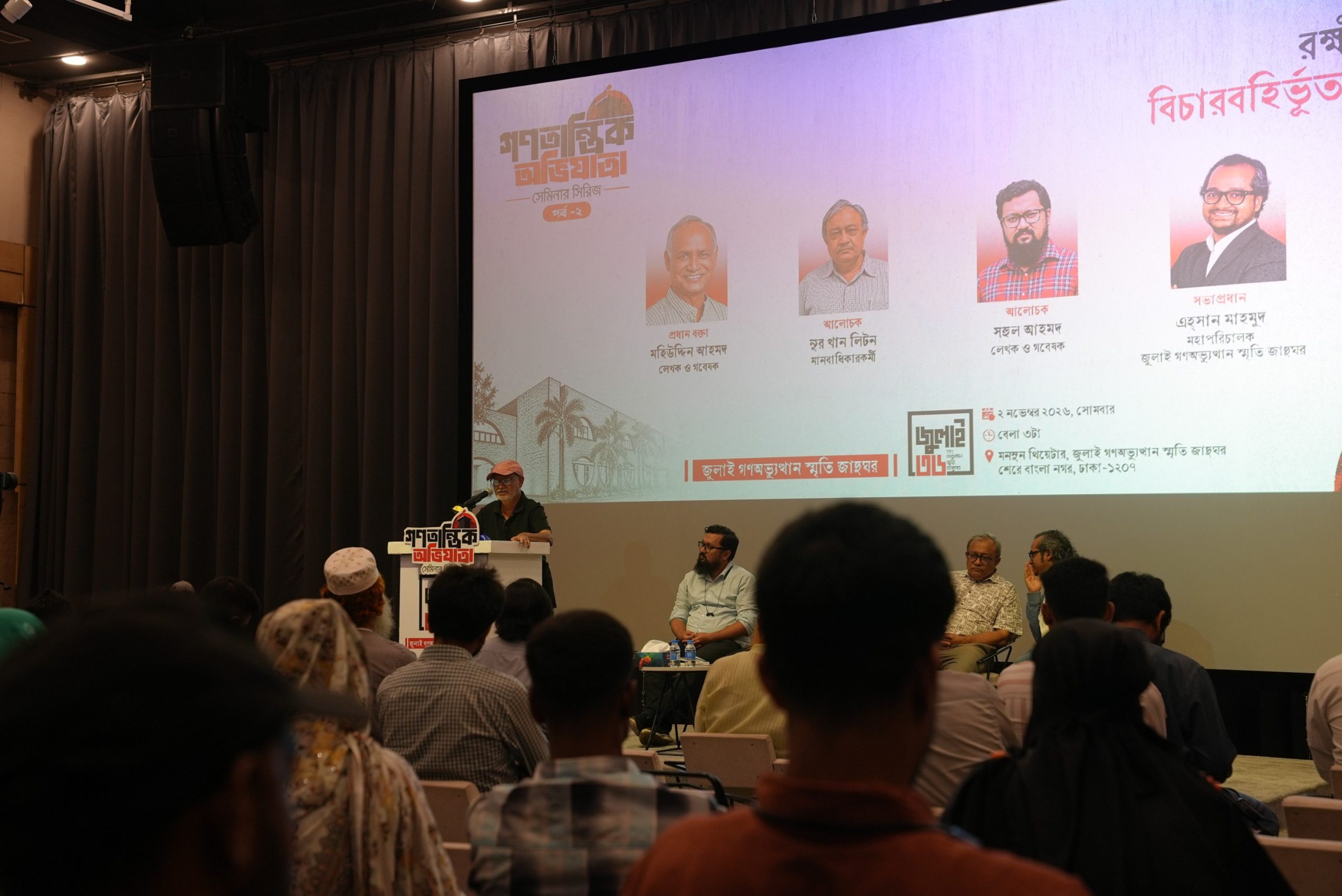
The remarks came at the second session of the ‘Democratic Journey Seminar Series’, organised by the July Mass Uprising Memorial Museum. The seminar, titled ‘Rakkhi Bahini and Extrajudicial Killings’, was held at the museum on November 2, with writer and researcher Mohiuddin Ahmad delivering the keynote address.
Mohiuddin Ahmad said many people identify the killing of Siraj Sikder in January 1975 as the first extrajudicial killing in independent Bangladesh. However, he argued that such an account overlooks hundreds of alleged extrajudicial killings attributed to the Rakkhi Bahini since 1972.
He said the Awami League had used the force to serve its political interests after independence. While the Rakkhi Bahini was deployed to recover land allegedly occupied from members of the Hindu community, it was also used to suppress opposition political leaders and activists, he added. According to him, activists of the Jatiya Samajtantrik Dal (JASAD) were among the worst victims of the force’s alleged abuses.
Describing the culture of impunity as a major reason behind the continuation of extrajudicial killings, Mohiuddin said members of the Rakkhi Bahini should have been brought to justice after 1975. However, successive political actors used the issue for political purposes without pursuing accountability, he alleged.
Referring to allegations concerning Ziaur Rahman’s involvement in the assassination of Sheikh Mujibur Rahman, he said Sheikh Hasina repeatedly raised the issue politically but did not establish an inquiry commission during her 16 years in power.
Human rights activist and former member of the Commission of Inquiry on Enforced Disappearances Nur Khan Liton said the Rakkhi Bahini subjected men and women to severe torture. The force was particularly active in areas where opposition groups, including JASAD, had a strong organisational presence, he added.
He also said the Rakkhi Bahini’s uniform resembled that of the Indian Army at the time, creating fear among ordinary people.
Referring to the period between 1972 and 1975, Liton said unidentified bodies were frequently found on the road between Rokeya Hall and Shamsunnahar Hall at Dhaka University. He suggested that the bodies might have been left there by the force to create fear among the public.
Writer and researcher Sohul Ahmed, another speaker at the seminar, called for an independent Truth Commission to establish the facts surrounding extrajudicial killings over the past five decades, beginning in 1972.
He said law enforcement agencies, from the Rakkhi Bahini to contemporary forces, had repeatedly presented similar explanations involving arms recovery and firing in self-defence in connection with allegations of extrajudicial killings.
The tendency to present self-defence and extrajudicial killings as interchangeable concepts, he said, raised questions about loopholes in the country’s Penal Code.
Presiding over the seminar, Ehasan Mahamud, director general of the July Mass Uprising Memorial Museum, said the Rakkhi Bahini and BAKSAL were among the most feared terms for ordinary people in the years following independence.
He said the museum launched the ‘Democratic Journey Seminar Series’ to examine important episodes in the country’s political history. The first session focused on BAKSAL, while the second addressed the Rakkhi Bahini.
Mahamud said historical documents, books and newspaper reports were available on various periods of Bangladesh’s history, but relatively little research had been conducted on the period between 1972 and 1975.
He added that the July Mass Uprising had offered a vision for a new Bangladesh, but building a democratic future required an honest examination of the past. Referring to the post-independence political developments, he alleged that one-party rule, the closure of newspapers other than state-owned publications and the formation of the Rakkhi Bahini marked a period of state-sponsored repression.
Teachers, researchers, lawyers, students and representatives of civil society attended the seminar. The organisers said further sessions of the seminar series would be held in phases.
What do you feel about this post?

Like

Love

Happy

Haha

Sad