
Online Desk:
Students attending classes from remote areas, AI-powered personalised learning and robots assisting with household chores were among the technologies showcased at the Bangladesh TechConnect 2026 conference in Dhaka.
The conference, jointly organised by the Posts and Telecommunications Division and Huawei, was held at the Bangladesh-China Friendship Conference Centre on Tuesday. The exhibition featured demonstrations of smart schools, connected homes, renewable energy solutions and various AI-powered technologies.
One of the main attractions was a model smart school, demonstrating how students in districts such as Tangail and Rajshahi could attend classes conducted by teachers from other parts of the world through large screens. Artificial intelligence could also help tailor teaching methods to individual students’ needs, potentially expanding access to quality education in remote areas.
A model called the ‘Smart Connection House’ demonstrated how AI and robotics could make everyday household activities easier through connected devices and automated systems.
The energy section featured technologies for generating solar power and storing electricity in batteries for later use. Huawei showcased solar inverters and lithium battery systems designed to store electricity for use when needed.
Alongside the exhibition, the conference featured discussions on the potential use of artificial intelligence across different industries and services, including the ready-made garment sector, ports, agriculture, healthcare, banking and goods transportation.
Speakers said AI and automation could help increase productivity and reduce operational costs. However, they stressed that these benefits would depend on reliable digital infrastructure, a skilled workforce, quality data and supportive policies.
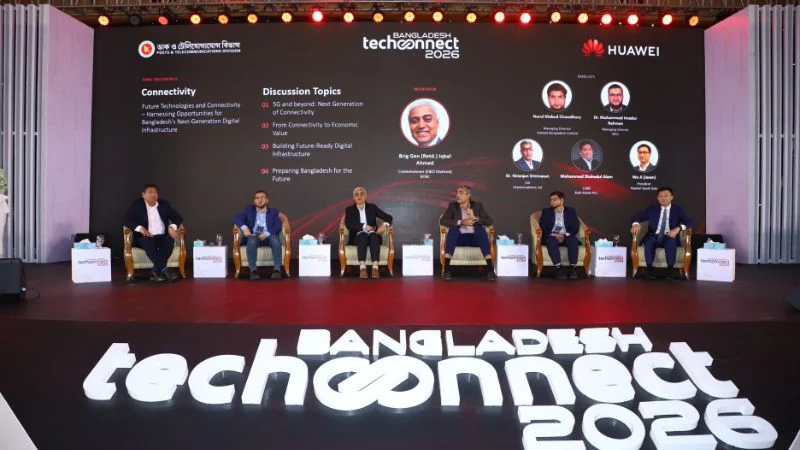
Three panel discussions were held on ‘Future Technology and Connectivity’, ‘The Role of Technology in Enhancing Industrial Efficiency’ and ‘Artificial Intelligence: Global Trends, Impacts and Bangladesh’s Preparedness’.
Participants said the benefits of digital connectivity should not be measured solely by internet coverage. Its impact on people’s access to education, healthcare and business opportunities should also be considered.
The sessions were moderated by Bangladesh Telecommunication Regulatory Commission Chairman Major General (retd) Md Emdad-ul-Bari, Additional Secretary of the Ministry of Science and Technology Syeda Naushin Parnini, and Director General of the National Cyber Security Agency Md Tayebur Rahman. Representatives from the telecommunications, technology, education, insurance and public sectors took part in the discussions.
Speaking at the conference, Posts and Telecommunications Minister Fakir Mahbub Anam said the government was working to create one million jobs in the digital sector over the next five years and establish Bangladesh as a regional hub for information technology and artificial intelligence.
He highlighted the need for high-speed, affordable internet connectivity, a skilled technology workforce and increased investment to achieve the targets. He also stressed the importance of ensuring cybersecurity and protecting personal data alongside the expansion of digital technologies.
Information and Communication Technology Division Secretary Md Mamunur Rashid Bhuiyan said work was underway to formulate a national AI policy. The government hoped to complete the process within the next three to four months.
What do you feel about this post?

Like

Love

Happy

Haha

Sad