Chattogram Reporter:
Three-wheeled vehicles continue to ply major highways in Chattogram in defiance of restrictions, raising concerns over road safety as a series of collisions have left people dead and injured.
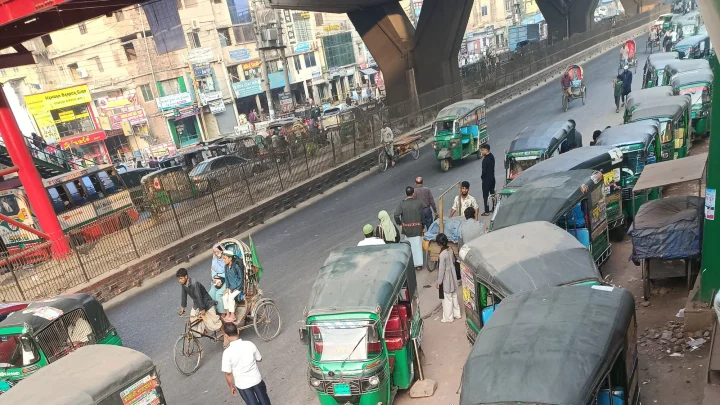
CNG-run auto-rickshaws, battery-powered rickshaws, easybikes and locally operated Tomtoms are frequently seen on the Dhaka-Chattogram, Chattogram-Cox’s Bazar, Chattogram-Khagrachhari and Chattogram-Rangamati highways.
Highway police have acknowledged the risks posed by these vehicles but say they face obstacles in enforcing the restrictions.
Nurul Absar, officer-in-charge of Dohazari Highway Police Station, told Bangla Tribune that three-wheelers were a significant safety concern because many drivers lacked proper training. He also alleged that political pressure and the influence of powerful quarters prevented police from taking full enforcement action.
The continued presence of these vehicles has raised questions about the effectiveness of existing restrictions and the enforcement agencies’ ability to keep highways safe.
Several accidents reported on Chattogram’s highways in recent months illustrate the dangers associated with mixed traffic involving large and small vehicles.
On September 5, two people were killed and three others seriously injured in a head-on collision between a bus and a CNG-run auto-rickshaw on the Chattogram-Cox’s Bazar highway in Chandanaish.
On October 7, another head-on collision between a bus and an auto-rickshaw near Noyakhal Pathani Bridge in Satkania left two people dead and another passenger injured.
On October 9, three auto-rickshaw passengers were seriously injured when the vehicle collided head-on with a microbus in Patiya.
Earlier, on February 27, an auto-rickshaw and a mini-truck collided in Adhunagar, Lohagara, killing one person and injuring seven others, including a child.
Other serious crashes have also been reported. Six people were injured in a collision involving an auto-rickshaw and a microbus near Modern Hospital in Sitakunda on March 28. On May 31, a multi-vehicle collision involving a bus, a drum truck, a microbus and a CNG-run auto-rickshaw near Barabkunda Bazar on the Dhaka-Chattogram highway killed one person and injured 25.
The scale of the problem is also reflected in estimates of the number of vehicles operating in the district.
Titu Chowdhury, general secretary of the Chattogram Auto-Rickshaw and Auto-Tempo Owners’ Association, said the district had around 63,000 registered CNG-run auto-rickshaws, including 13,000 in the city and 50,000 in other areas of the district.
He estimated that another 50,000 unregistered CNG-run auto-rickshaws were operating across the city and district. In addition, several hundred thousand Tomtoms, easybikes and battery-powered rickshaws were also on the roads.
Chowdhury alleged that restrictions on three-wheelers were not being properly enforced, allowing unauthorised vehicles to continue operating on highways and increasing accident risks.
The figures are estimates provided by the association and could not be independently verified.
Road users and transport-sector representatives say the risks are compounded by the absence of dedicated service lanes on many stretches.
Nurul Alam, a resident of Mirsharai municipality, said accidents frequently occurred at the highway U-turn near Mirsharai municipal market. He said unauthorised three-wheelers sometimes travelled against the direction of traffic, creating additional hazards.
Truck and bus drivers have also raised concerns about vehicles manoeuvring through U-turns in the Mirsharai section of the Dhaka-Chattogram highway, where they say the lack of dedicated turning lanes forces vehicles to negotiate difficult movements amid fast-moving traffic.
Mohammad Mozammel Haque Chowdhury, secretary general of the Passengers’ Welfare Association, said three-wheelers and non-motorised vehicles were using lanes intended for buses and other highway traffic.
He said the lack of separate service lanes and what he described as inadequate enforcement were contributing to the risks.
Mohammad Shahjahan, joint general secretary of the Bangladesh Road Transport Owners’ Group, also blamed the continued operation of unauthorised three-wheelers for increasing highway accident risks. He said bus drivers often faced the blame for collisions even when smaller vehicles were involved.
Although restrictions on three-wheelers have been in place for years, enforcement remains a major challenge, according to highway police.
The High Court issued a restriction in October 2012 on CNG-run auto-rickshaws operating on highways. However, the vehicles continue to appear on major routes in Chattogram.
The allegations of political interference and pressure from influential quarters made by the highway police officer raise questions about whether enforcement agencies have sufficient operational freedom to implement the restrictions.
The immediate challenge is to ensure compliance with existing rules while addressing the lack of safe alternative routes for local transport users.
Without consistent enforcement, safer road infrastructure and better driver training, the risks posed by the mixing of slow-moving three-wheelers with buses and trucks are likely to remain a major concern on Chattogram’s highways.
What do you feel about this post?

Like

Love

Happy

Haha

Sad