

Tanvir Raihan:
Bangladesh’s listed power and energy companies are experiencing sharply contrasting financial fortunes, with major petroleum distributors reporting strong profits while several electricity and gas utilities struggle with mounting losses, weakening cash flows and declining asset values.
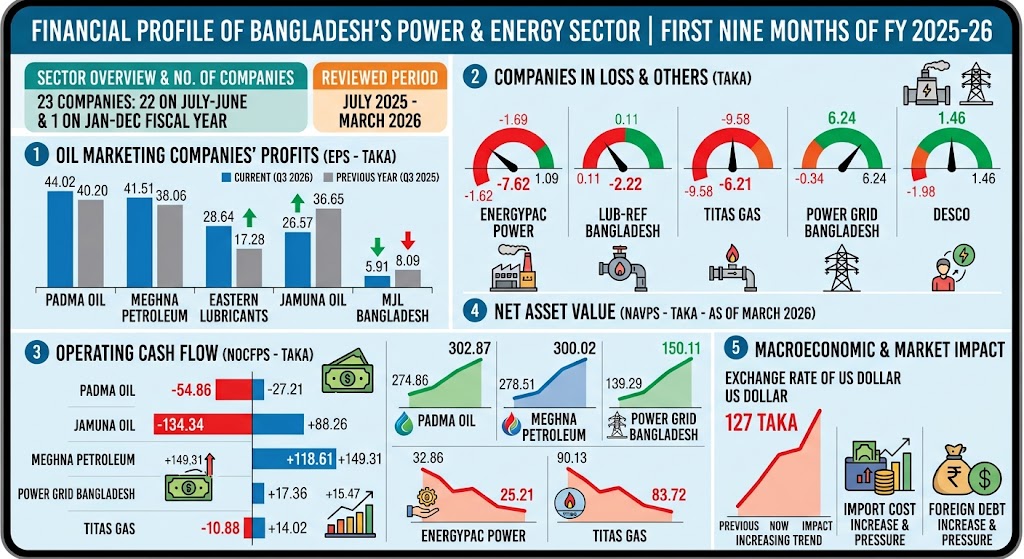
An analysis of the latest published financial statements shows that Padma Oil and Meghna Petroleum recorded earnings per share (EPS) of more than Tk 40 in the first nine months of the 2025-26 financial year. In contrast, Energypac Power and Titas Gas remained in the red, while several other companies reported declining earnings or negative operating cash flows despite remaining profitable.
The figures highlight the differing business models and cost structures across the sector, where petroleum marketing companies have maintained relatively strong earnings while power generation, transmission and gas distribution businesses face pressure from infrastructure costs, fuel expenses and foreign exchange movements.
Of the 23 listed companies in the power and energy sector, 22 follow a July-June financial year. Most have published financial results for the nine months from July 2025 to March 2026. Linde Bangladesh follows a January-December financial year and has reported its results for January-September 2026.
Padma Oil topped the sector in earnings per share during the July 2025-March 2026 period, posting EPS of Tk 44.02, up from Tk 40.20 in the corresponding period a year earlier. The increase amounted to Tk 3.82 per share.
Meghna Petroleum also reported strong growth, with EPS rising to Tk 41.51 from Tk 38.06, an increase of Tk 3.45.
However, not all petroleum marketers improved their earnings. Jamuna Oil’s EPS fell to Tk 26.57 from Tk 36.65 in the same period of the previous financial year, a decline of Tk 10.08 per share.
Eastern Lubricants recorded a notable improvement, with EPS increasing to Tk 28.64 from Tk 17.28. In contrast, MJL Bangladesh’s EPS declined to Tk 5.91 from Tk 8.09, while United Power Generation and Distribution Company’s earnings fell to Tk 14.69 from Tk 19.32.
Linde Bangladesh reported EPS of Tk 17.78 for January-September 2026, down from Tk 18.80 in the corresponding period of 2025.
The results suggest that petroleum distribution businesses continue to generate substantial earnings, although performance varies among individual companies.
Several companies in the electricity and gas segments continue to face financial difficulties.
Energypac Power recorded one of the steepest deteriorations in the sector. Its loss per share widened to Tk 7.62 in the first nine months of FY2025-26 from Tk 1.09 in the corresponding period a year earlier.
Lub-ref (Bangladesh) also moved from profit to loss. The company reported a loss per share of Tk 2.22, compared with earnings of Tk 0.11 in the same period of the previous financial year.
Titas Gas remained loss-making, although its loss per share narrowed to Tk 6.21 from Tk 9.58.
GBB Power and Intraco Refuelling Station remained profitable but recorded sharp declines in earnings. GBB Power’s EPS slipped to Tk 0.09 from Tk 0.10, while Intraco Refuelling Station’s earnings fell to Tk 0.15 from Tk 1.08.
The broader picture, however, is not uniformly negative for electricity companies.
Baraka Power’s EPS rose to Tk 0.87 from Tk 0.29, while Baraka Patenga Power’s earnings increased to Tk 2.86 from Tk 0.74. CVO Petrochemical Refinery also recorded a significant improvement, with EPS climbing to Tk 5.08 from Tk 2.35. Summit Power’s EPS edged up to Tk 1.47 from Tk 1.46.
Dhaka Electric Supply Company (DESCO) returned to profitability, reporting EPS of Tk 1.46 after posting a loss of Tk 1.98 per share in the corresponding period of the previous financial year.
Power Grid Bangladesh also made a turnaround, moving from a loss of Tk 0.34 per share to earnings of Tk 6.24.
Shahjibazar Power’s EPS increased to Tk 4.37 from Tk 1.83, while Khulna Power Company’s earnings rose to Tk 0.73 from Tk 0.13.
While earnings provide an important measure of corporate performance, operating cash flow offers a clearer indication of how much cash a company generates through its regular business activities. Weak cash generation can create difficulties in meeting operating expenses, servicing liabilities and financing future investments, even when a company reports accounting profits.
The latest figures reveal significant weaknesses in the operating cash flows of some profitable petroleum marketers.
Padma Oil’s operating cash flow per share stood at negative Tk 54.86 in the first nine months of FY2025-26, compared with negative Tk 27.21 in the corresponding period a year earlier. The deterioration came despite an increase in the company’s EPS.
Jamuna Oil’s operating cash flow per share was negative Tk 134.34, compared with positive Tk 88.26 in the same period of the previous financial year.
Meghna Petroleum, by contrast, maintained positive operating cash flow. Its cash flow per share stood at Tk 118.61, although this was lower than Tk 149.31 recorded in the corresponding period a year earlier.
The electricity and gas segments also showed mixed results.
DESCO’s operating cash flow per share increased to Tk 13.85 from Tk 8.98, while Power Grid Bangladesh’s figure rose to Tk 17.36 from Tk 15.47.
Titas Gas, however, experienced a sharp deterioration, with operating cash flow per share falling to negative Tk 10.88 from positive Tk 14.02.
Baraka Patenga Power’s operating cash flow per share worsened to negative Tk 8.62 from negative Tk 5.48. Baraka Power also moved into negative territory, recording negative Tk 0.40 per share against positive Tk 4.37 in the previous year’s corresponding period.
These figures indicate that reported profits alone may not fully reflect a company’s financial strength. Operating cash flow, working capital requirements and the ability to meet payment obligations are also important indicators of financial health.
Net asset value (NAV) per share also reflects the divergent performance of companies in the sector.
At the end of March 2026, Padma Oil’s NAV per share stood at Tk 302.87, up from Tk 274.86 at the end of June 2025. Meghna Petroleum’s NAV increased to Tk 300.02 from Tk 278.51, while Jamuna Oil’s rose to Tk 281.28 from Tk 274.03.
Power Grid Bangladesh’s NAV per share increased to Tk 150.11 from Tk 139.29. Eastern Lubricants recorded an increase to Tk 162.91 from Tk 139.60, while United Power’s NAV rose to Tk 82.08 from Tk 73.89.
The picture was less favourable for several financially troubled companies. Energypac Power’s NAV per share fell to Tk 25.21 from Tk 32.86, while Lub-ref Bangladesh’s declined to Tk 30.50 from Tk 32.72. Titas Gas also experienced a fall, with NAV per share dropping to Tk 83.72 from Tk 90.13.
Declining NAV does not, by itself, establish the cause of a company’s financial difficulties, but it indicates a reduction in the reported net asset value attributable to each share.
Industry representatives and market participants point to differences in investment requirements, pricing arrangements and operating costs to explain why petroleum marketers are generally performing better than some power companies.
Farhana Akhter, company secretary of Meghna Petroleum, said the company did not follow any special policy to generate consistent profits.
“We are conducting our business and making profits. Everything the company has is disclosed in the annual report,” she said.
Mohammad Sattar Hossain, company secretary of GBB Power, said he could not explain why petroleum companies were earning more than electricity companies. However, he attributed the decline in his company’s profits to the closure of one of its plants.
Moniruzzaman, managing director of Prime Bank Securities, said power companies require substantial investment to develop infrastructure, including transmission lines, cables and other facilities needed to supply electricity across the country.
“Large amounts of money have to be invested in infrastructure, but the income or profits generated from those investments do not always reach the expected level,” he said, explaining that the mismatch puts pressure on companies’ finances.
He also pointed to foreign currency borrowing by some power companies. Although the dollar was relatively cheaper when some of these loans were taken, the subsequent rise in the exchange rate increased the amount of money required in taka to repay both principal and interest.
According to Moniruzzaman, petroleum marketing companies such as Padma Oil, Meghna Petroleum and Jamuna Oil operate under a different business model. Their principal activities involve procuring petroleum products and distributing them across the country, rather than building the extensive infrastructure required by electricity transmission companies.
He said the scope to earn a margin within the prescribed pricing structure could also help petroleum marketers maintain relatively stable profitability.
Minhaz Mannan Emon, a director of the Dhaka Stock Exchange (DSE), similarly attributed the difference partly to the pricing and cost structures of the two segments.
“Petroleum companies earn from the difference between purchase and selling prices,” he said, arguing that this margin helps explain their stronger profitability.
Power generation companies, however, face a different set of pressures, he said. Electricity production depends on fuels such as oil, gas and coal, and higher fuel prices increase generation costs. If electricity tariffs are not adjusted in line with those increases, companies must absorb the additional burden.
Emon also highlighted the impact of the depreciation of the taka. He said the dollar exchange rate had risen from around Tk 90 to Tk 127, increasing the cost of imported machinery and other equipment without a corresponding rise in electricity selling prices.
He added that power producers previously benefited from various revenue streams and facilities, including capacity payments, which were no longer available to the same extent, according to his assessment. Higher production costs and limited opportunities to increase revenue had therefore contributed to financial pressure on some companies.
The latest financial results reveal a sector divided between petroleum marketers with strong reported earnings and utilities facing a range of operational and financial challenges.
Padma Oil and Meghna Petroleum have maintained EPS above Tk 40, while Energypac Power and Titas Gas continue to report losses. At the same time, negative operating cash flow at Padma Oil and Jamuna Oil demonstrates that strong accounting profits do not necessarily guarantee robust cash generation.
The contrasting performance of DESCO and Power Grid Bangladesh also shows that financial difficulties are not universal across the electricity segment.
For investors, the key question is therefore not simply whether a company is making a profit. Earnings growth, operating cash flow, net asset value, debt-servicing capacity and the underlying business model all need to be assessed together to understand the sustainability of its financial performance.
What do you feel about this post?

Like

Love

Happy

Haha

Sad