
Tanvir Raihan:
Bangladesh’s expanding higher education sector is facing growing concerns over faculty shortages, with seven universities reportedly having no professors and dozens of institutions employing fewer than 10 permanent professors, according to education statistics. Experts warn that the shortage of senior academics could affect research supervision, academic leadership and the quality of university education.
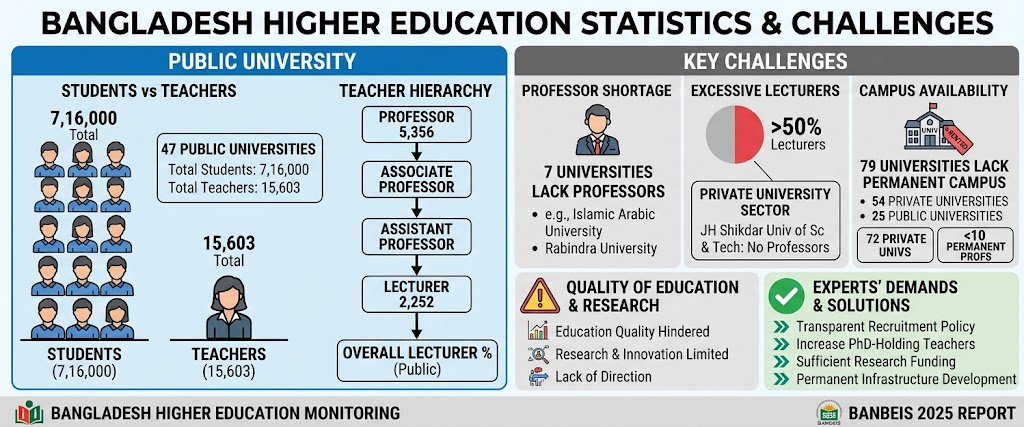
The Bangladesh Education Statistics 2025, published by the Bangladesh Bureau of Educational Information and Statistics (BANBEIS), provides a picture of uneven faculty distribution across the country’s universities. The figures cited in the report indicate that Bangladesh has 180 universities, while 47 public universities currently conducting academic activities have approximately 716,000 students and 15,603 teachers.
Of the teachers in these public universities, 5,356 are professors and 2,252 are lecturers. However, the overall figures mask significant differences between institutions, particularly in the availability of experienced academics.
Islamic Arabic University, Rabindra University, Khulna Agricultural University and Jamalpur Science and Technology University are among the institutions reported to have no professors. The statistics further indicate that 11 universities have fewer than 10 professors each.
Khulna Agricultural University has 93 teachers, of whom 62 are lecturers. Meanwhile, Gopalganj Science and Technology University has only two professors for 8,733 students, raising questions about the availability of senior academic guidance for such a large student population.
A shortage of professors does not necessarily mean that teaching has stopped, as lecturers and other faculty members also conduct classes. However, a limited number of senior academics can place additional pressure on research supervision, postgraduate education, curriculum development and departmental leadership.
The figures highlight the need to assess not only the number of teachers but also their qualifications, experience, research responsibilities and distribution across academic departments.
The situation is also concerning in the private university sector. According to the figures cited, 105 private universities employ 16,885 teachers, including 8,855 lecturers—more than half of their total teaching workforce.
Z H Sikder University of Science and Technology, Feni University and Central University of Science and Technology reportedly have no permanent or part-time professors. In addition, 72 private universities have fewer than 10 permanent professors.
These figures raise questions about whether institutions have sufficient senior faculty members to support advanced teaching, supervise research and develop academic programmes. The extent of the problem, however, may vary considerably between universities and disciplines.
Dr Manzoor Ahmed, emeritus professor at BRAC University, has attributed part of the problem in private universities to reluctance to recruit senior academics because of cost considerations.
He has called for clear recruitment and promotion policies, alongside a structured career framework for university teachers. Such arrangements could help institutions retain experienced academics while providing teachers with transparent opportunities for professional advancement.
Former acting chairman of the University Grants Commission (UGC), Dr Alamgir Hossain, has stressed the need to increase the number of teachers holding PhD degrees. He has also called for long-term planning to address the shortage.
Expanding the number of PhD-qualified teachers would require more than recruitment targets. Universities would also need adequate research funding, access to academic resources and working environments that encourage qualified researchers to pursue teaching careers in Bangladesh.
Faculty shortages are not the only challenge facing the sector. According to the UGC, 54 private universities and 25 public universities do not have their own permanent campuses and operate from rented premises.
The lack of permanent campuses can create difficulties in developing adequate classrooms, laboratories, libraries and research facilities. It may also limit opportunities for extracurricular activities and broader academic engagement, although conditions differ among institutions.
The campus issue, combined with uneven faculty distribution, highlights the need for a comprehensive assessment of universities’ academic and infrastructure capacity.
UGC Chairman Professor Dr Mamun Ahmed has acknowledged that some university departments are being run by only one or two lecturers.
He said initiatives were being taken to involve Bangladeshi teachers and researchers living abroad in efforts to address the shortage.
Engaging expatriate academics could help universities access international research experience and specialised expertise. However, experts’ concerns also point to the importance of strengthening domestic recruitment, retaining experienced teachers and establishing transparent promotion systems.
The figures suggest that expanding the number of universities alone cannot guarantee quality higher education. Institutions also need qualified teachers, experienced academic leadership, adequate research facilities and sustainable infrastructure.
A long-term strategy could include university-specific faculty assessments, transparent recruitment and promotion policies, increased opportunities for doctoral training, stronger research funding and clear plans for institutions without permanent campuses.
Regular publication of data on vacancies, faculty qualifications, professor-to-student ratios and research output could also improve accountability and help students make informed decisions.
Higher education is expected not only to award degrees but also to generate knowledge, support innovation and prepare skilled graduates. Addressing the shortage of senior academics will therefore remain a major challenge for Bangladesh’s universities and education policymakers.
What do you feel about this post?

Like

Love

Happy

Haha

Sad