
Staff Reporter:
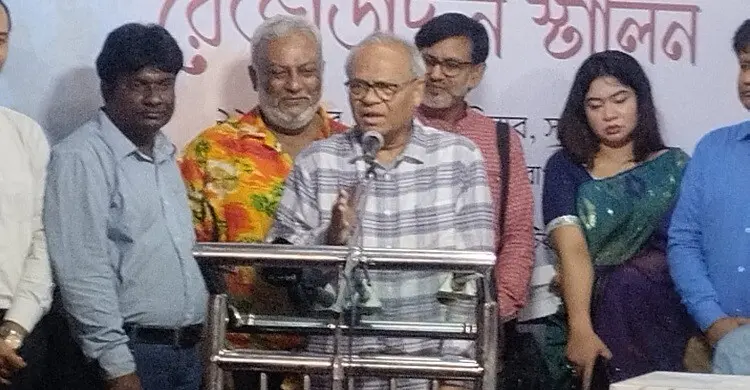
Poetry has no hierarchy of big and small poets, as every poet reigns supreme in his or her own distinct world, BNP Acting Secretary General Advocate Ruhul Kabir Rizvi has said.
Recalling his childhood perception of poets, Rizvi said he once thought they were self-absorbed people like ascetics, with unusual manners and ways of speaking. He even believed that poets probably did not bathe for six months.
He made the remarks as the chief guest at a programme marking the birthday of poet Rezauddin Stalin at the Sanskriti Bikash Kendra in Paribagh, Dhaka, on Sunday night.
Rizvi said his perception had changed after meeting Stalin, describing him as an example of how a poet could be smart and well-groomed. He also praised Stalin’s lifestyle and social conduct, saying he was an accomplished member of society.
Clarifying that he was not a theoretical authority on poetry or literature, Rizvi said he was not a literary person in the way Shahin Reza had presented him. He did not know the conventions of discussing or speaking about literature and poetry, he added, noting that literary discussions and presentations had their own distinct styles.
Recounting advice from one of his Bengali teachers about poetic inspiration and relationships with women, Rizvi said renowned poets often needed to be careful in their personal lives.
A poet might have many female friends who could inspire poetry, he said, recalling his teacher’s advice that poets should not become too deeply involved in such relationships, as doing so could undermine their creative talent. He compared the approach to throwing a stone into a pond and then walking away.
Praising Stalin’s social and family life, Rizvi said the poet maintained excellent relationships with people from different walks of life. He said Stalin would be difficult to match as a public relations officer at any prominent institution.
Despite being highly sociable, Stalin returned to his wife and daughter at the end of the day, Rizvi said. Even while engaged in conversations, he remembered his wife’s instructions to buy onions, small fish and salt before returning home. Rizvi described this as another remarkable quality of the poet.
Recalling the anti-autocracy movement, Rizvi said that although he had never been deeply immersed in poetry, he was an admirer and enthusiast of the art.
During the anti-Ershad movement and his periods in prison, the motivational poems of poet Mohan Rayhan had inspired him, he said. Although they belonged to different student organisations at the time, participants in the movement had united around a common goal. Rizvi added that he also recited those poems to attract the attention of friends and fellow students.
Describing Stalin as an “autonomous and sovereign” poet, Rizvi said he had created an inner world through his poetry, reflected in every letter and sentence. His ability to preserve his independent identity, he said, had enabled him to develop a distinct poetic style.
Rizvi also quoted English poet P B Shelley’s famous line, “Poets are the unacknowledged legislators of the world”, and a passage from Rabindranath Tagore: “Antar hote ahori bachan / Anandaloke kori birachan”.
The greatest achievement of a poet, he said, was the ability to draw words from within and take readers into that world of joy.
What do you feel about this post?

Like

Love

Happy

Haha

Sad