

International Desk:
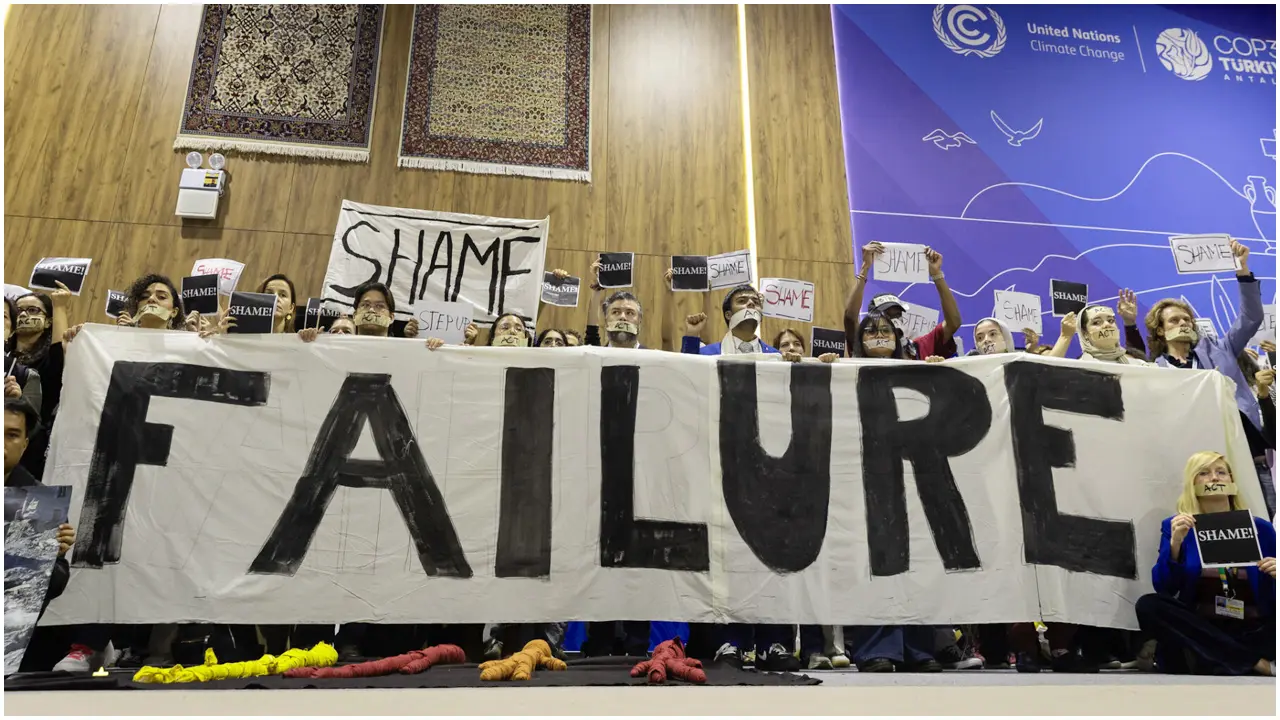
The 31st UN Climate Change Conference (COP31) ended without an overarching agreement after countries failed to bridge deep divisions over the future of fossil fuels and financial support for developing nations struggling with the impacts of climate change.
The two-week summit in Antalya, Türkiye, continued nearly two days beyond its scheduled conclusion but failed to secure consensus on a proposed political agreement, known as the Antalya Pact.
The European Union (EU) and several other countries rejected the proposed deal, arguing that it failed to address the need to move away from fossil fuels, the main driver of global warming. The EU said the draft did not reflect the urgency of the climate crisis or align with scientific recommendations.
After weeks of negotiations, the COP presidency presented the proposed agreement. However, the EU made clear that it could not endorse a final decision that did not explicitly mention fossil fuels.
Speaking on behalf of the bloc, Ireland’s climate minister Darragh O’Brien said the EU would not support an agreement that ignored fossil fuels, warning that such an approach would widen the gap between international climate commitments and the action required to meet them.
Panama also formally objected to the proposed agreement, describing it as a step backwards in addressing the climate crisis. The country argued that the deal should acknowledge the world’s collective failure to keep global warming within the 1.5-degree Celsius threshold set under the Paris Agreement.
The Marshall Islands, which faces an existential threat from rising sea levels, also opposed the proposed decision.
“We will not compromise our future to benefit fossil fuel interests,” its delegation said.
Russia supported the omission of language calling for an accelerated phase-out of fossil fuels, arguing that oil and gas remain necessary energy sources and that countries should determine their own pathways to reducing emissions.
Pakistan and Ghana, meanwhile, defended the proposed agreement as a necessary compromise to preserve multilateral cooperation.
Climate finance emerged as another major point of contention at the summit.
Developing countries blamed the EU and other wealthy nations for failing to provide adequate funding to help vulnerable countries adapt to extreme weather events and deal with the damage caused by climate change.
The EU, one of the world’s largest providers of climate finance, has resisted new adaptation funding targets.
The final draft decision proposed further discussions on an implementation pathway to triple adaptation finance by 2035, but did not specify a financial target.
It also estimated that developing countries would need around $300 billion annually for climate adaptation until 2035, while expressing concern over the widening gap between available climate finance and actual needs.
Although governments failed to reach an agreement on moving away from fossil fuels during the formal negotiations, a separate initiative known as Transition Away from Fossil Fuels (TAFF) is gaining momentum.
Tuvalu’s Minister for Climate Change and Environment, Maina Talia, said the initiative would move beyond debates over whether fossil fuels should be mentioned in the final text and focus instead on developing detailed plans for a global energy transition.
Several countries, including Ireland, Denmark, the Netherlands, France, Germany and Finland, have already developed or are working on national roadmaps to reduce their dependence on fossil fuels.
However, Brandon Wu, director of policy and campaigns at ActionAid USA, criticised these efforts, describing them as inadequate without stronger financial commitments from wealthy nations.
He called COP31 one of the most disappointing climate conferences, accusing the EU and other developed countries of failing to demonstrate solidarity, cooperation and a willingness to compromise.
COP31 took place against growing scientific expectations that global temperatures would exceed 1.5 degrees Celsius above pre-industrial levels, a threshold central to the Paris Agreement.
However, countries remained divided over how to respond to the anticipated overshoot.
The proposed draft decision urged governments to limit the extent of the overshoot as much as possible, warning that every additional increment of warming would increase risks to people and natural systems, with some impacts potentially irreversible.
It also stressed the need for deep, rapid and sustained reductions in greenhouse gas emissions.
The summit had been viewed as particularly significant following a series of climate-related disasters around the world. Europe experienced deadly heatwaves, while a glacier collapse in Nepal killed more than 1,400 people.
At the same time, geopolitical instability and rising global oil prices brought renewed attention to energy security and the future of fossil fuels.
Despite the urgency of these challenges, countries failed to reach consensus on the summit’s overarching political agreement, highlighting the continuing divisions over how to tackle the climate crisis.
What do you feel about this post?

Like

Love

Happy

Haha

Sad