

News Desk:
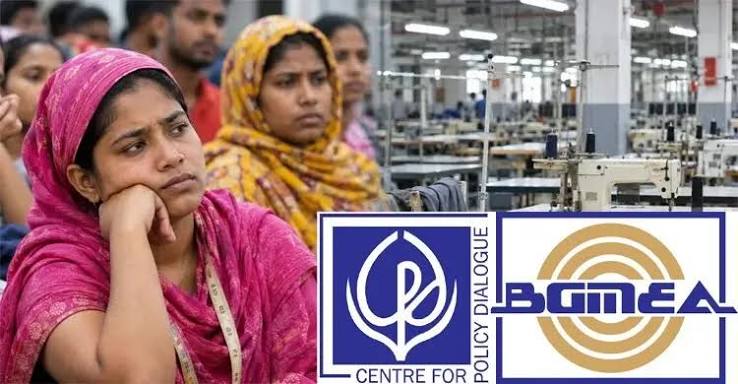
The Bangladesh Garment Manufacturers and Exporters Association (BGMEA) has sought clarification from the Centre for Policy Dialogue (CPD) on several methodological and data-related aspects of its proposal for setting the minimum wage for garment workers. Source: BSS
The apparel manufacturers’ association believes that the methods used by the CPD to calculate the size of workers’ families, the number of earning members, poverty lines and non-food expenditure need to be reconsidered. It has also called for production costs and the industry’s international competitiveness to be taken into account when determining minimum wages.
The BGMEA presented its observations and recommendations in a letter sent to CPD Executive Director Dr Nazneen Ahmed on November 19.
In the letter, the BGMEA said the CPD had used the median of five studies to estimate an average garment worker’s family size at four members, with 1.58 earning members. However, the association argued that using the mean rather than the median would be more appropriate.
It pointed out that the CPD’s own 2023 survey found an average of 3.7 members and two earning members per garment worker’s family. Meanwhile, Bangladesh Bureau of Statistics (BBS) data show that the average household size nationwide declined from 4.66 members in 2004 to 3.96 in 2023.
Regarding the poverty line, the BGMEA said the CPD had considered only the higher poverty line for Dhaka city in its calculations for the entire garment industry. Instead, it argued, a weighted average of regional higher poverty lines should be used, based on the concentration of factories and exports in different areas.
According to the association, factories located in Dhaka city accounted for only 9 per cent of the country’s total garment exports in the 2025-26 fiscal year.
The BGMEA also expressed concern that adding Tk 10,000 in housing costs to non-food expenditure could result in double counting, as housing costs are already included in the non-food expenditure calculation.
The letter further said that although the minimum wage of Tk 12,500, set in December 2023, had been adjusted for inflation, subsequent annual increments had not been taken into account. It specifically mentioned the 9 per cent increment granted in 2024. The association also called for a clear CPD assessment of the wages proposed by workers’ representatives for other grades.
Highlighting the industry’s current situation, the BGMEA said production costs had increased by 25 to 30 per cent over the past three years, while export prices had declined by 2.6 per cent. Interest rates on bank loans had risen to between 12 and 16 per cent, and export incentives had been reduced by nearly 70 per cent. During the same period, 287 garment factories had closed, it said.
The letter also presented a comparative picture of minimum wage increases in Bangladesh and competing countries.
According to BGMEA data, the minimum wage in Bangladesh increased by 136 per cent between 2016 and 2026. The corresponding increases were 59 per cent in India, 54 per cent in Vietnam and 50 per cent in Cambodia.
The association said gas and electricity shortages, declining investment, policy uncertainty and challenges related to Bangladesh’s graduation from the least developed country (LDC) category were also putting pressure on the industry’s international competitiveness.
Against this backdrop, the BGMEA urged the CPD to consider not only minimum wage levels but also the industry’s average wage costs, production expenses and international competitiveness as part of a broader assessment.
It also sought the CPD’s cooperation in developing a transparent, rational and evidence-based framework for determining wages.
What do you feel about this post?

Like

Love

Happy

Haha

Sad