

Tanvir Raihan:
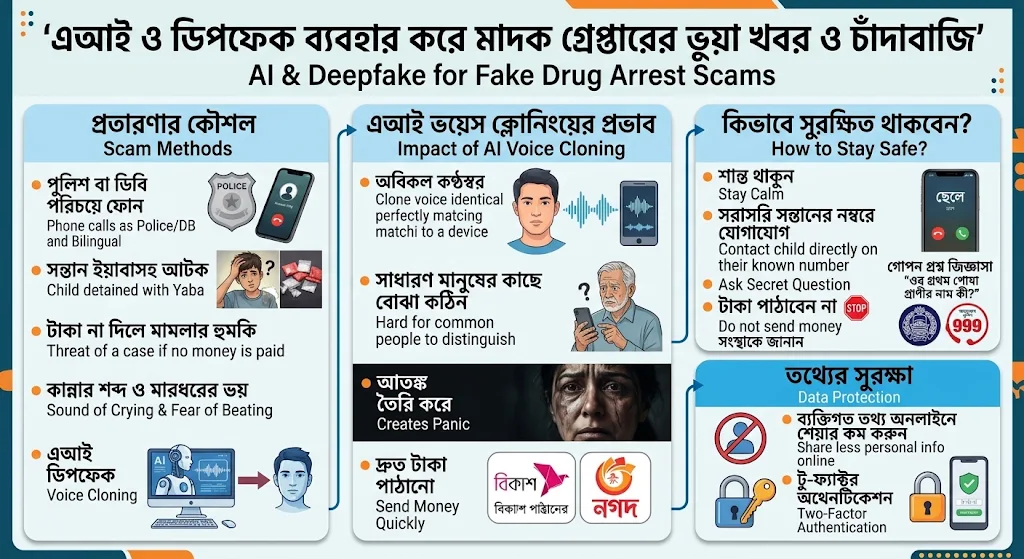
A phone call claiming that a son has been arrested with drugs is being used to frighten parents into sending money. Callers posing as police or Detective Branch (DB) officials threaten criminal charges unless payments are made immediately. To make their claims more convincing, some play sounds of beatings or use voices resembling those of the victims’ children pleading for help. The growing use of artificial intelligence (AI), along with stolen personal information and SIM cards registered under other people’s identities, has added new dimensions to the fraud.
Abul Kalam Azad, a resident of Barishal Sadar, recently received such a call. A man identifying himself as an assistant sub-inspector of police claimed that drugs had been found in his son’s bag and that a mobile court was preparing to sentence him. The caller demanded Tk120,000 to secure his release.
Although alarmed by the news, Azad did not send the money. He contacted his son through a familiar phone number and found that he was at his workplace in Dhaka. There had been no arrest.
In another incident on November 14, the family of Jisan Hossain, an employee of a private bank, was targeted by someone claiming to be a DB official. The caller said Jisan had been detained with yaba and demanded Tk500,000 to prevent him from being formally charged in a drug case.
When Jisan’s father questioned the allegation, the caller claimed that a woman had also been detained with his son and that yaba had been found in her possession. The caller then played sounds of an apparent beating. A voice resembling Jisan’s followed, crying and pleading: “Abbu, Abbu, save me. Give them whatever they want.”
The family tried calling Jisan’s familiar number but found it switched off. When his father said he could not arrange Tk500,000, the callers pressed him to send whatever amount he could manage. After he agreed to pay Tk20,000, two men allegedly arrived beneath the family’s home in Mirpur-12 and collected the money.
The family later contacted Jisan through another number and learned that he was attending training at his office. Jisan said the voice played during the call had sounded almost identical to his own.
A similar attempt was made against Raich Uddin, a resident of Tarash in Sirajganj, on August 29. A caller identifying himself as a DB official first obtained the name and occupation of Uddin’s son through conversation. He then claimed that the young man had been arrested with yaba and demanded Tk300,000, threatening to implicate him in a drug case.
About 10 minutes later, another number called and played what sounded like the son crying. The caller again demanded an immediate payment. Uddin, however, contacted his son through a familiar number and confirmed that he was at work.
Technology experts say AI tools can be used to imitate familiar voices, making such schemes more convincing. Audio samples collected from social media videos, recordings and other sources can be used to generate artificial voices. As a result, hearing a familiar voice over the phone is no longer sufficient to establish that the person is actually speaking.
Professor BM Mainul Hossain of the Institute of Information Technology at the University of Dhaka said deepfake technology had made this type of fraud considerably easier. Paid AI services can generate voices that closely resemble those of real people, making it difficult for ordinary listeners to distinguish between authentic and cloned speech.
He advised people to be cautious about sharing personal information online and to enable two-factor authentication on their accounts. If someone receives a call claiming that a family member is in danger, they should avoid panicking and ask questions that only the family member would know how to answer. He also stressed the importance of public awareness about technology-enabled fraud.
The sources of the personal information used in these schemes remain a concern. According to sources familiar with law enforcement investigations, fraudsters may obtain phone numbers and other details from social media platforms, online shopping websites, customer databases held by financial institutions and databases exposed through information leaks. There are also allegations that dishonest employees of different organisations sell customers’ information for money.
Cybercrime investigators say some groups collect information about specific individuals and their families before making targeted calls. Others contact large numbers of people in the hope of finding potential victims. During conversations, callers may also manipulate parents into disclosing their children’s names, occupations and other identifying details.
Harun-or-Rashid, joint commissioner of the cyber unit of the Dhaka Metropolitan Police’s Detective Branch, said investigators did not have specific information about all the sources from which fraudsters obtained phone numbers. However, investigations into different cases had revealed several methods of collecting personal information. Police try to identify and arrest those involved after receiving complaints, he said, adding that investigators were also looking into the sources of the numbers used in the schemes.
Biometric SIM registration was introduced partly to verify subscribers’ identities and help law enforcement identify users of phone numbers involved in criminal activities. However, fraudsters continue to use SIM cards registered in other people’s names.
DB officials say that, in many cases, a person other than the registered subscriber uses the SIM card. The person whose identity was used for registration may not even know that the number is being used for criminal activities. Money obtained through fraud is also transferred through multiple bank or financial accounts, making it harder to trace the actual perpetrators.
Harun-or-Rashid said weaknesses remained in the biometric registration system. Investigations frequently found that SIM cards registered under one person’s name were being used by someone else. He said law enforcement agencies had conducted drives to recover such SIM cards, adding that 20,000 SIM cards were recovered in one operation and another 50,000 in a separate operation this year.
The DB official said the cyber unit regularly received complaints about this type of fraud. Police were taking legal action and trying to identify and arrest those involved. However, arrests alone would not be enough to prevent the schemes, and families also needed to remain alert.
He advised parents who receive calls claiming that their children have been arrested to contact them separately through familiar phone numbers. If necessary, they should verify the information with the child’s workplace, friends or close relatives. No money should be sent before the claim is independently confirmed.
Law enforcement officials also advise families to deal with any genuine arrest through the legal process rather than attempting to secure someone’s release by paying money. As technology makes impersonation and voice manipulation increasingly sophisticated, verifying information, protecting personal data and promptly reporting suspicious calls remain essential safeguards against such fraud.
What do you feel about this post?

Like

Love

Happy

Haha

Sad