Tanvir Raihan:
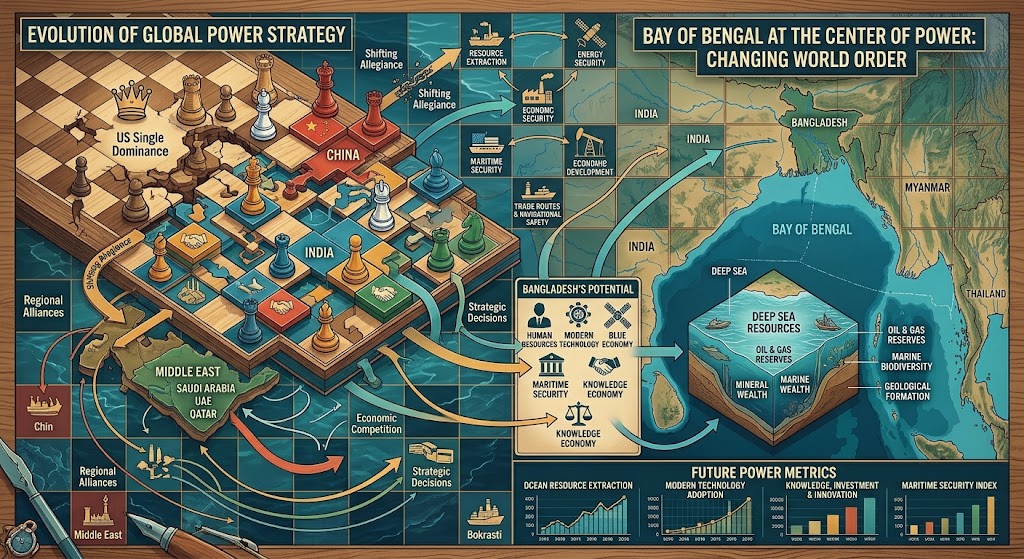
The world is passing through an extraordinary period of uncertainty. International politics, economic competition, military tensions, energy security and the struggle for strategic influence are reshaping the global order. The world increasingly resembles a vast chessboard, where powerful nations compete not only through visible confrontations but also through diplomacy, investment, technology, trade and control over strategic resources.
Whatever the explanations offered for the current global instability, Bangladesh is certainly not its principal driving force. The roots of international tensions lie largely in the competing ambitions of major powers. The United States, China, Russia, India and influential Middle Eastern countries are pursuing strategic interests that increasingly overlap and sometimes directly conflict.
For decades, the United States has occupied a dominant position in the international system. Its economic strength, military presence, technological leadership and diplomatic influence have shaped global affairs. However, the sustainability of this dominance is increasingly being questioned. The rise of China, India’s expanding economic influence and the growing financial and strategic ambitions of Middle Eastern countries are contributing to a gradual redistribution of global power.
The coming decades could witness a more multipolar world in which China, India and the resource-rich nations of the Middle East play increasingly influential roles. China has established itself as a major manufacturing and technological power. India possesses a vast consumer market, a growing industrial base and an increasingly significant geopolitical position. Meanwhile, countries such as Saudi Arabia, the United Arab Emirates and Qatar are diversifying their economies and expanding investments in technology, infrastructure, finance and international trade.
This does not necessarily mean that the United States will disappear from the centre of global affairs. Rather, its relative dominance may face greater challenges as other powers strengthen their positions. The emerging competition could gradually transform the existing international order from a predominantly US-led system into a more complex arrangement of competing economic and strategic centres.
One geographical region that deserves particular attention in this changing landscape is the Bay of Bengal.
For Bangladesh, the Bay of Bengal is far more than a body of water bordering its southern coastline. It is a strategic gateway connecting South Asia with Southeast Asia and the wider Indo-Pacific region. Its importance extends to international shipping, maritime security, energy transportation, regional connectivity and access to potential natural resources.
The strategic significance of the Bay of Bengal is also linked to the growing competition among major powers in the Indo-Pacific. China seeks to strengthen its regional connectivity and maritime presence, while India considers the surrounding waters essential to its security and economic interests. The United States also attaches considerable importance to freedom of navigation and strategic stability in the region.
Consequently, Bangladesh’s geographical position gives it considerable strategic relevance. However, geographical importance alone cannot guarantee economic or diplomatic advantages. The country must develop the scientific, technological and institutional capacity to understand and utilise its maritime potential.
One particularly important area is the largely unexplored potential of the deep-sea environment. Although research and exploration have been conducted in the Bay of Bengal, considerable opportunities remain for further investigation into its seabed geology, marine biodiversity, fisheries, energy resources and possible mineral deposits.
The seabed could hold valuable information about geological formations and potential natural resources. Understanding these possibilities requires advanced marine research, modern exploration technology and sustained scientific investment. Bangladesh should therefore place greater emphasis on oceanographic research and deep-sea exploration.
The question is not simply how much wealth may lie beneath the Bay of Bengal. It is also about who possesses the knowledge, technology and capacity to explore, manage and sustainably utilise those resources.
For Bangladesh, this represents both an opportunity and a responsibility. The country should not allow its maritime importance to be defined solely by the strategic calculations of larger powers. Instead, it must establish its own long-term vision based on national interests, scientific knowledge, economic development and balanced diplomacy.
Strengthening maritime research institutions, developing skilled professionals, investing in deep-sea technologies and expanding regional cooperation should become national priorities. Bangladesh must also ensure that any exploration or development of marine resources respects environmental sustainability and international maritime law.
The international arena is, in many ways, an unpredictable game. Alliances change, economic interests shift and yesterday’s competitors can become tomorrow’s partners. Behind many visible international developments are complex negotiations, long-term strategies and calculations that ordinary observers may never fully understand.
The real challenge for Bangladesh is to avoid becoming merely a piece on someone else’s geopolitical chessboard. It must develop the ability to understand the game, protect its interests and negotiate with confidence.
The future of global power will not be determined solely by military strength or territorial size. Control over technology, energy, trade routes, scientific knowledge and maritime resources will increasingly shape the international balance.
Perhaps one of the most consequential geopolitical stories of the coming decades will unfold across the waters of the Indian Ocean and the Indo-Pacific. And the Bay of Bengal could emerge as one of its most important chapters.
For Bangladesh, the time to prepare for that future is now.
What do you feel about this post?

Like

Love

Happy

Haha

Sad