Editorial:
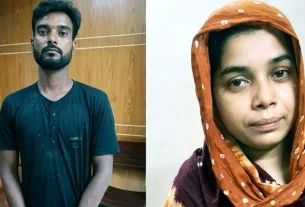
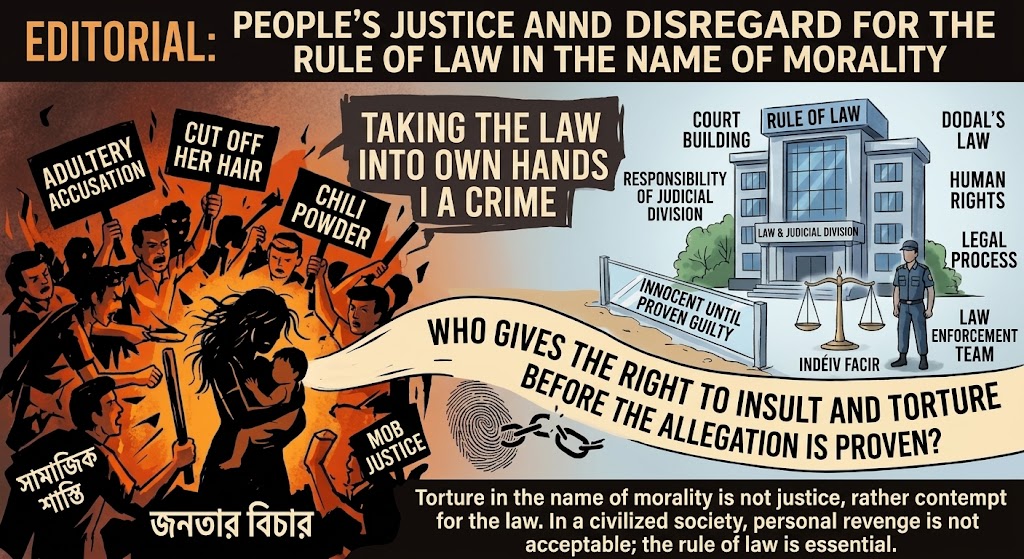
In society, people often appoint themselves as judges of others in the name of morality. When suspicions arise about someone’s private life, those suspicions are sometimes treated as established facts, leading to public humiliation, social ostracism and even physical abuse. Yet, in a civilised society, no individual or group has the right to punish someone based on allegations. The authority to deliver justice rests with the courts, and taking the law into one’s own hands can itself constitute a criminal offence. A recent incident in Jhenaidah Sadar Upazila, where a woman was allegedly beaten, had her hair cut off and chilli powder applied to her body over accusations of an extramarital affair, highlights this disturbing tendency.
According to published reports, the woman was assaulted on October 22 in Korotipara village of Jhenaidah. Instead of verifying the allegations or seeking legal recourse, several people allegedly took it upon themselves to act as judges and punishers. Her son was also reportedly struck with a stick when he tried to protect his mother. Regardless of whether the allegations were true or false, such treatment of a woman and her family members is wholly unacceptable.
The issue here extends beyond violence against an individual woman. It raises a fundamental question: is personal retaliation increasingly taking the place of the justice system in our society? Even if someone is suspected of engaging in an improper relationship, nobody has the right to storm into that person’s home, inflict physical harm or subject them to public humiliation. The state has established institutions and procedures for verifying allegations, gathering evidence and taking legal action. Bypassing these mechanisms to impose punishment is not justice; it is a direct affront to the rule of law.
Social reactions to alleged extramarital relationships often reveal a troubling imbalance. When a woman is accused, her private life, character and social standing frequently become subjects of public scrutiny. She may be humiliated or subjected to physical abuse. But are the roles, responsibilities and conduct of the men involved questioned with the same intensity? This is a question worth considering.
In the Jhenaidah incident, the allegation that the wife of the man implicated in the alleged relationship personally cut the woman’s hair is particularly disturbing. Personal resentment, marital conflict or emotional distress can never justify stripping another human being of dignity. Those who feel wronged have lawful avenues for seeking redress; they have no right to inflict abuse in the name of revenge.
It is even more dangerous when violence against women is portrayed as a means of preserving social order. Cutting someone’s hair, smearing chilli powder on their body or beating them does not uphold moral values. Such acts instead undermine human dignity, personal freedom and security.
Section 497 of Bangladesh’s Penal Code contains provisions concerning adultery. However, its scope is specific: it provides for punishment of the man involved in the circumstances defined by the law, while the woman is not punishable as an abettor under that provision. The prescribed punishment is imprisonment for up to five years, a fine, or both. The applicability of the provision in any particular case depends on the circumstances and relevant facts.
More importantly, the existence of a legal provision concerning adultery does not authorise anyone to impose punishment privately. Even if an allegation is true, action must be taken through lawful procedures. If an allegation is false, those responsible for malicious accusations or abuse must also be held accountable.
Similarly, assault, intimidation, humiliation and acts such as applying chilli powder to someone’s body may carry legal consequences. Such allegations require impartial investigation, and responsibility must be established on the basis of evidence. A person does not acquire the authority to punish others simply because they have been declared guilty in the court of public opinion.
Community mediation has a long tradition in rural Bangladesh. Although it can sometimes help resolve local disputes, it must never become a pretext for beating, humiliating or physically abusing anyone. When allegations about personal relationships become the basis for mob justice, the process can easily degenerate into retaliation, abuse of power and violence.
The administration and law enforcement agencies have an important role to play in such cases. They must ensure impartial investigations, protect the victim and take appropriate legal action against those responsible. Public awareness must also be strengthened so that people understand a basic truth: abusing someone in the name of morality is not an expression of moral values.
People may hold different views about extramarital relationships and marital conduct. Religious, ethical and social perspectives may also vary. But none of these differences can legitimise violence. Even when someone objects to another person’s private conduct, that person’s right to humane treatment, legal protection and an opportunity to defend themselves must remain intact.
The incident in Jhenaidah, therefore, cannot simply be dismissed as an isolated act of violence in a village. It demonstrates how dangerous the exercise of power in the name of morality can become. Attempting to humiliate and punish someone before establishing the truth undermines the very principles of justice.
The hallmark of a civilised society is not how harshly its members can judge one another, but how faithfully they uphold the law and act justly. It is imperative to replace personal grievances with the rule of law, retaliation with due process, and humiliation with respect for human dignity. Otherwise, abuse in the name of morality will continue, while the rule of law remains confined to the pages of legal texts.
What do you feel about this post?

Like

Love

Happy

Haha

Sad