Dr. Muhammad Idris Bhuiyan
Saudi Arabia today is a state that identifies itself as Muslim. But the question is whether a state’s religious identity and the human values reflected in its system of governance are one and the same. In my view, there is a deep contradiction between the power and conduct of the Saudi monarchy and Islam’s ideals of equality, justice and humanity.
Does going to Makkah necessarily bring one closer to Allah? Does visiting Madinah automatically enable one to feel the presence of Prophet Muhammad (peace be upon him) in one’s heart? Is being physically present at holy sites or witnessing the grandeur of religious structures enough to achieve spiritual enlightenment? I believe the answers must be sought in human conscience, faith and conduct.
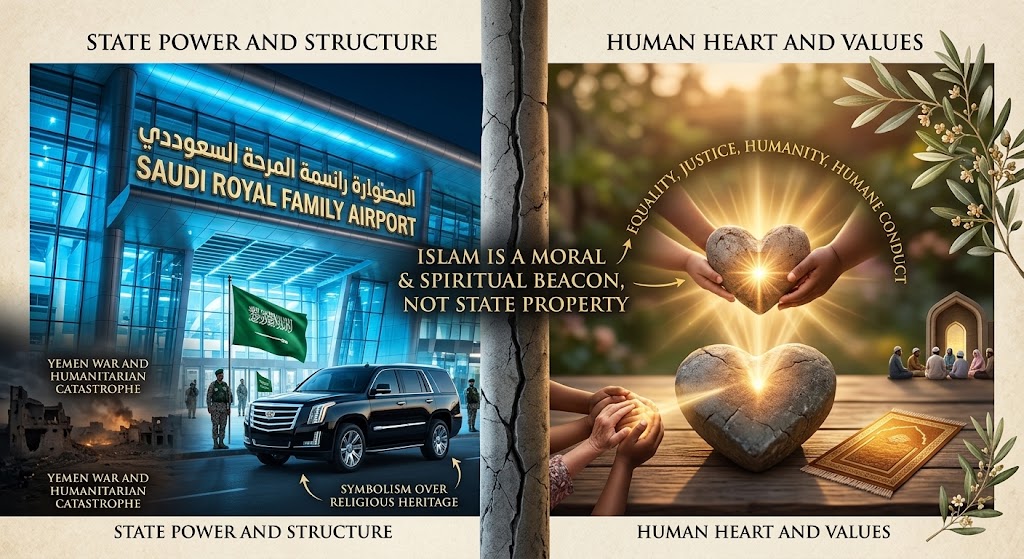
A closer look suggests that members of the Saudi royal family feature prominently in the naming of the country’s airports. This raises another question: how many airports, if any, are named after important prophets, caliphs or companions of the Prophet who played significant roles in Islamic history? The way a state honours the religious heritage and ideals that have shaped Muslim identity deserves discussion.
The Saudi ruling establishment also places considerable emphasis on its identity as the Custodian of the Two Holy Mosques in Makkah and Madinah. But does the responsibility of serving these sacred cities end with constructing, expanding and managing infrastructure? Or does it also entail a duty to uphold justice, demonstrate humanity, protect human dignity and stand beside the oppressed?
The war in Yemen and the suffering of civilians there have raised serious questions about Saudi Arabia’s regional policies. Countless children, women and other civilians have lost their lives, while homes, hospitals and mosques have been destroyed. The responsibility for these events, the roles played by the parties involved and the full extent of the humanitarian catastrophe require evidence-based examination. No state action carried out in the name of religion should be beyond humanitarian accountability.
My question is this: can the religious legitimacy of a system of governance whose actions contribute to the loss of human life, the violation of human dignity and damage to religious sites be established solely through its claim to maintain the two holy cities?
The beauty of Makkah and Madinah, their magnificent mosques, monumental architecture of stone and concrete, steel structures and dazzling illumination may captivate the eye. But can such splendour awaken the human conscience? The outward beauty of religious structures and the purity of the human heart are not the same thing.
I believe that Allah must be sought within the heart, while the teachings of Prophet Muhammad (peace be upon him) must be reflected in our lives. The beauty of Islam is expressed through love for others, justice, honesty, equality and humane conduct.
Regrettably, the tendency to look down on people based on power and social status exists in many societies. Criticism of Saudi Arabia’s system of governance and social practices also raises a fundamental question: how long will inequality and degrading treatment of people be considered acceptable when concealed behind a religious identity?
Where conscience, a sense of justice and humanity deteriorate, boasting about the sanctity of a structure cannot fulfil the true purpose of religion. A mosque is a place of worship; but if the lessons of that worship are not reflected in human behaviour, the very significance of religious practice comes into question.
Islam is not confined to structures made of stone and concrete. It lives in the human heart, in conscience and in righteous conduct. Islam’s egalitarian and humane teachings are reflected not in the arrogance of monarchy, but in protecting human dignity and establishing just relationships among people.
I therefore wish to see an awakening of conscience rather than blind obedience. Instead of the unchecked dominance of any state or ruling establishment in the name of religious authority, I hope to see justice, humanity and accountability prevail.
In conclusion, Islam is not the property of the Saudi monarchy. It is a moral and spiritual beacon for all humanity. No state, royal family or power structure can claim exclusive ownership of this beacon. The true strength of Islam lies not in royal splendour, but in the human heart; not in domination, but in justice; and not in blind obedience, but in an awakened conscience.
-A legal professional and columnist.
This editorial article reflects the free expression of Dr. Muhammad Idris Bhuiyan’s views.
What do you feel about this post?

Like

Love

Happy

Haha

Sad