Tanvir Raihan:
Repeated allegations of sexual abuse involving students at madrasas across Bangladesh have raised questions about the effectiveness of child protection mechanisms, institutional accountability and the enforcement of existing safeguards. Despite court directives, government oversight structures and internal management committees, recent cases have highlighted concerns over whether complaints are being handled properly and whether vulnerable students have safe channels to report abuse.
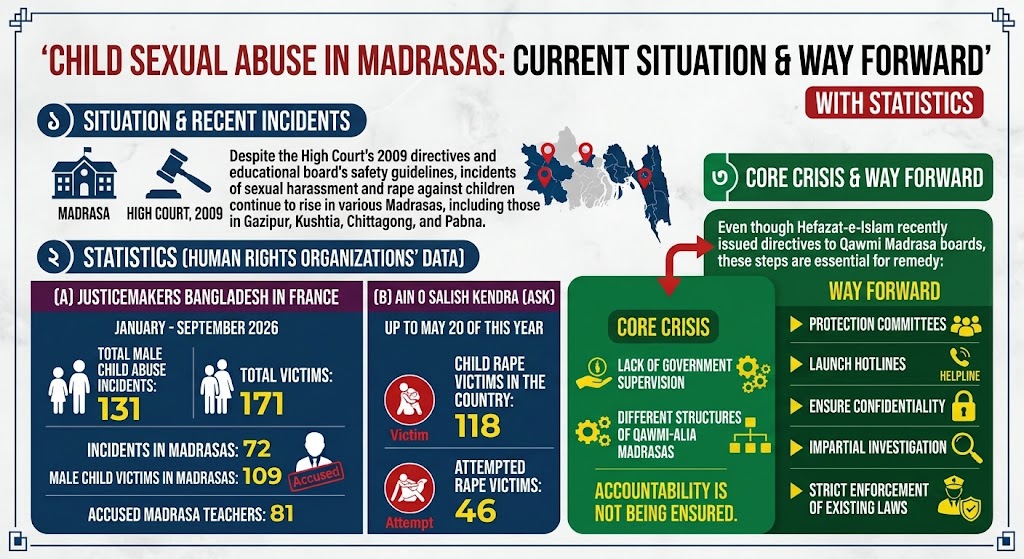
In recent weeks, allegations have emerged from madrasas in Gazipur, Kushtia, Chattogram and Pabna, involving teachers and institutional officials accused of sexual harassment, attempted rape and other forms of abuse. Several suspects have been arrested in connection with the cases. The allegations remain subject to investigation and judicial proceedings.
In Tongi and Gacha in Gazipur, cases were filed over alleged sexual abuse involving children at two Qawmi madrasas. In one case in Gacha, the complaint reportedly alleged that the institution failed to take action after the family raised concerns about a teacher. Investigators will have to establish the facts surrounding the allegations.
In Daulatpur upazila of Kushtia, a teacher was arrested over an allegation of attempted rape involving a nine-year-old student. In Banshkhali, Chattogram, a madrasa headteacher was arrested in August over allegations of repeatedly sexually abusing an eight-year-old student.
Similar allegations have also surfaced at Alia madrasas, which operate under a different educational and administrative framework. In Kasba, Brahmanbaria, a teacher at a Dakhil madrasa was accused of raping a sixth-grade student, prompting a criminal case.
The incidents have renewed concerns about complaint-handling procedures, the protection of children in residential institutions and the accountability of authorities responsible for student welfare.
According to monitoring by JusticeMakers Bangladesh in France, 131 incidents of sexual violence against boys involving 171 victims were documented between January and September 2026. Of those incidents, 72 reportedly occurred at madrasas, involving 109 boys. The organisation recorded allegations against 81 madrasa teachers in the cases.
Separately, Ain o Salish Kendra (ASK), a Bangladeshi human rights organisation, reported that 118 children were raped and 46 faced attempted rape between January and May 20 this year.
However, these figures do not establish the overall prevalence of sexual abuse in madrasas nationwide. The organisations rely on reported incidents and their own monitoring, and the available data do not provide a comprehensive institution-by-institution account of abuse.
ASK Senior Coordinator Abu Ahmed Faizul Kabir told that the organisation does not maintain separate statistics for individual types of institutions. He noted that sexual violence and harassment occur in madrasas as well as other educational settings.
The absence of comprehensive, institution-specific data makes it difficult to assess the full scale of the problem or compare trends across different educational systems.
On May 14, 2009, the High Court issued guidelines to prevent sexual harassment in workplaces and educational institutions. The directives included forming complaint committees, investigating allegations and recommending appropriate action.
The guidelines stipulate that a committee should be headed by a woman and include at least two members from outside the institution. Its responsibilities extend beyond receiving complaints to examining allegations and recommending action where necessary.
The Bangladesh Madrasah Education Board issued instructions on April 30, 2019, directing affiliated madrasas to establish committees to prevent sexual harassment. The Directorate of Madrasah Education had also issued a notice on the matter earlier that month.
Yet the existence of guidelines does not necessarily mean they are being implemented effectively. Questions remain about whether committees are operational, whether students and guardians know how to contact them and whether complaints receive timely and impartial investigations.
Alia madrasas fall under the oversight framework of the Bangladesh Madrasah Education Board and relevant government agencies. Qawmi madrasas, by contrast, operate under their own educational boards and management structures. Their oversight arrangements are therefore not identical.
Clarifying responsibilities for child protection, complaint investigation and monitoring across both systems is essential to ensuring that allegations are addressed consistently and lawfully.
Muhammad Mozammel Hossain Khan, director for administration and finance at the Directorate of Madrasah Education, told Bangla Tribune that the directorate regularly issues instructions on preventing sexual abuse and harassment.
He said monitoring was conducted through upazila-level secondary education officials, but the directorate did not have its own direct field-level monitoring structure.
Khan acknowledged the need to strengthen oversight and said the directorate would work to improve implementation of its instructions.
The arrangement raises questions about how consistently institutions are inspected, how compliance is assessed and what action follows when a madrasa fails to respond appropriately to a complaint.
In a statement issued on October 24, Hefazat-e-Islam Bangladesh said instructions had been given to establish or reactivate student protection committees across six Qawmi madrasa education boards and their affiliated institutions.
According to the statement, complaints involving student abuse or misconduct should be investigated and reports submitted within seven days. The instructions also call for stronger monitoring cells and hotlines through which allegations can be reported.
The organisation said affiliation could be suspended or cancelled if an institution failed to establish a protection committee, maintain an effective committee or take appropriate action on a complaint.
The announcement signals an effort to strengthen internal safeguards, but its effectiveness will depend on implementation, independent scrutiny and transparent action on complaints.
Religious Affairs Minister Kazi Shah Mofazzal Hossain, also known as Kaykobad, described incidents of this nature as deeply regrettable and shameful while speaking to journalists in Dhaka on October 24. He said the government would take necessary steps to prevent their recurrence.
Children may remain silent about sexual abuse because of fear, shame, social pressure or threats from people in positions of authority. Those living in residential madrasas may face additional difficulties because they are separated from their families.
Allegations that complaints were ignored or that institutions failed to act have made the availability of safe reporting channels a central concern. Students and guardians need to know where they can seek help without fear of retaliation.
Child protection experts and rights advocates have emphasised the importance of functioning complaint committees, impartial investigations and accountability when allegations are mishandled.
Safeguards should include clear reporting procedures, confidentiality, regular inspections of residential facilities and appropriate referral to law enforcement when allegations may constitute criminal offences. Institutions must also ensure that students are not threatened or pressured into withdrawing complaints.
At the same time, allegations must be investigated fairly, and suspects should not be treated as guilty before the judicial process establishes responsibility.
The recent cases have exposed the gap that can exist between formal safeguards and their practical enforcement. Establishing committees and issuing instructions are important steps, but they cannot replace active monitoring, accessible complaint mechanisms and timely investigations.
Authorities responsible for Alia and Qawmi madrasas need clearly defined responsibilities and effective coordination. Institutions should document complaints, protect victims from intimidation and ensure that allegations are referred to the appropriate authorities.
The newly announced protection committees and hotlines will require transparent implementation and regular evaluation to determine whether students can use them safely and whether complaints lead to appropriate action.
Ultimately, the effectiveness of child protection measures will be measured not by the number of directives issued or committees formed, but by whether children can report abuse safely, receive protection and obtain justice through a fair legal process.
What do you feel about this post?

Like

Love

Happy

Haha

Sad