Editorial:
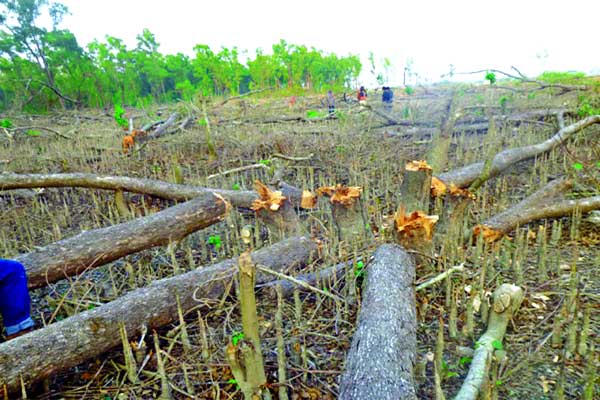
Development in Bangladesh is often measured in terms of new roads, industries, housing projects and tourist facilities. Such projects are assessed largely for their potential to attract investment, create jobs and generate revenue. However, the long-term economic costs of hill cutting, deforestation, river encroachment and the filling of water bodies are rarely given adequate consideration. Ultimately, the entire society bears the cost of environmental destruction.
The environmental crises facing Cox’s Bazar, the coral reefs of St Martin’s Island, the coastal forests of Kuakata, the hills of Bandarban and the Sada Pathor area of Sylhet raise a common question: are we weakening the foundations of future income and livelihoods in pursuit of short-term profits from natural resources?
Building resorts by cutting hills may generate profits for investors. Selling stones extracted from rivers can bring immediate revenue. Filling wetlands for housing projects can increase land values. But who bears the cost of landslides, declining tourist attractions, biodiversity loss, waterlogging and shrinking livelihood opportunities for local communities? Much of this damage remains outside the financial calculations of the projects responsible.
A study has reported that the area covered by rivers, canals, ponds and other water bodies in Dhaka and its surrounding wider study area declined by approximately 83.4 per cent between 1776 and 2025. The loss of water bodies reduces the natural capacity to retain and drain rainwater. Consequently, the cost of tackling waterlogging rises, placing a greater burden on city residents and public funds.
In economics, such damage is known as a “negative externality”—a situation in which an individual or business gains from an activity while others bear its costs. Nature works in much the same way. Forests absorb carbon, wetlands retain water, and coastal forests help reduce the impact of cyclones. Although these services may not have a market price, they carry substantial economic value.
The World Bank’s 2024 Bangladesh Country Environmental Analysis, based on 2019 data, estimated that the economic cost of environmental health risks was equivalent to around 17.6 per cent of Bangladesh’s GDP. This figure does not directly measure the damage caused by deforestation or hill cutting, but it illustrates the broader economic burden of environmental degradation.
The success of development must therefore be measured by more than GDP growth or the construction of new infrastructure. Project assessments should account for social and environmental costs, local livelihoods and the long-term value of natural resources. Regular monitoring of forests, hills and water bodies, alongside effective enforcement of environmental laws, is also essential.
Nature-based tourism can create new economic opportunities. But tourism cannot be sustainable if it destroys the very natural attractions on which it depends. Cutting hills to profit from their beauty or encroaching on beaches to expand tourism businesses is not development; it is the sacrifice of future assets for present gains.
The benefits of development can never be fully measured without accounting for the damage inflicted on nature. Sustainable development requires us to treat nature not as a cost, but as a national asset.
What do you feel about this post?

Like

Love

Happy

Haha

Sad