

Staff Reporter:
Farmers in Bangladesh are watching their gourds and papayas rot in fields as farm-gate prices collapse, while consumers in Dhaka continue to pay significantly higher prices for the same produce. The widening gap has exposed weaknesses in the country’s agricultural marketing system, raising questions about the role of intermediaries, transport costs and the distribution of profits along the supply chain.
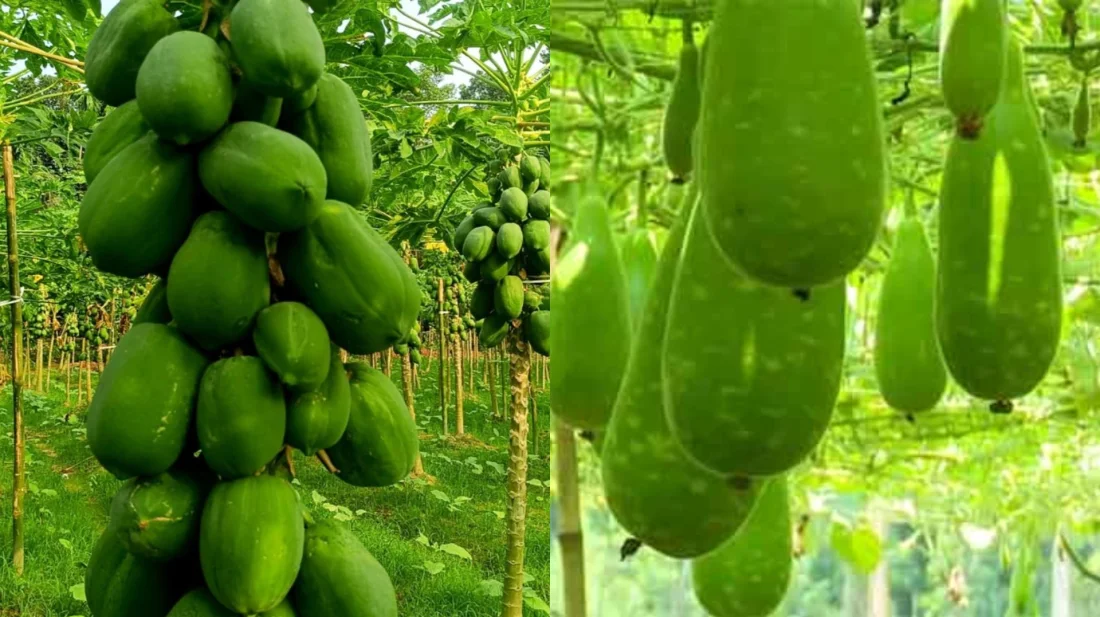
In some areas, four gourds are selling for just Tk 1, while papayas are fetching only Tk 2–3 per kilogram at the farm gate. Yet a single gourd costs Tk 40–60 in Dhaka’s retail markets, and papayas sell for around Tk 30 per kilogram.
For farmers, the prices are often too low even to cover harvesting and labour costs. Some are abandoning their crops, cutting down plants or leaving ripe produce to rot rather than spending more money to harvest it.
In Atwari upazila of Panchagarh, a good gourd harvest has failed to bring financial relief to growers. Increased production has flooded local markets, pushing prices far below their expectations.
Farmer Dulal Islam of Telipara in Mirzapur union invested Tk 60,000–70,000 to cultivate gourds on 40 decimals of land. However, he has earned only Tk 3,000 from the produce harvested so far.
He said the money was insufficient even to pay workers. After selling thousands of gourds for a negligible return, he was forced to cut down his garden. Some of the gourds are now being used as livestock feed.
Dulal questioned how farmers could continue cultivating crops if they failed to recover their investment despite months of hard work.
Another grower, Ansarul Islam of Jhaljhali Ular Chap, has stopped maintaining his gourd field because of mounting losses. He said fertiliser and pesticide prices had increased, while daily wages for agricultural workers had risen to Tk 600–700. With individual gourds selling for as little as Tk 2–5 in some places, continuing cultivation could deepen his losses.
The crisis is not confined to gourds. Papaya growers in Singair upazila of Manikganj are facing a similar situation as increased production coincides with weak market prices.
The Department of Agricultural Extension had set a cultivation target of around 900 hectares of papaya in Singair this season. Favourable weather, high-yielding varieties and an expansion of cultivated land have boosted production. But the increased supply has pushed prices down sharply.
In several areas, farmers are selling papayas directly from their fields for Tk 2–3 per kilogram. At that rate, they cannot recover the cost of seeds, fertilisers, pesticides, irrigation, land rent and labour.
Farmer Delwar Hossain of Gopalnagar village spent Tk 40,000–50,000 cultivating papaya on two bighas of land. Buyers, however, are offering only Tk 2–3 per kilogram, leaving him struggling to cover harvesting and transport expenses.
Another farmer, Tajul Sikder, has cut down papaya plants on two bighas after failing to recover even a small portion of his production costs. He is now considering alternative crops.
Growers fear that continued losses could discourage farmers from cultivating papaya in the next season.
The price slump has affected wholesalers and traders who advanced money to farmers before harvest.
In Dhaka’s Karwan Bazar wholesale market, green papayas have reportedly sold for Tk 4–10 per kilogram over the past week. The situation contrasts sharply with the previous year’s retail prices, which reportedly reached Tk 80–100 per kilogram during the same period.
Encouraged by last year’s high prices, some farmers and traders expanded production or increased advance payments, expecting another profitable season. The surge in supply has overturned those expectations.
Papaya trader Mahfuzur Rahman of Karwan Bazar said he had advanced Tk 3 crore to farmers in five districts, anticipating strong demand and favourable prices.
Instead, he sold papayas for Tk 6–7 per kilogram before prices dropped further to around Tk 4. Transporting papayas from Chuadanga and Jashore to Dhaka alone costs more than Tk 4 per kilogram, he said.
Mahfuzur expressed doubt that he would recover even Tk 50 lakh of his Tk 3 crore advance payments. He is also worried about repaying bank loans and interest.
Trader Azi Ullah brought three tonnes of papayas from Singair to Karwan Bazar. He estimated production costs at Tk 10–12 per kilogram, including land rent, seeds and fertilisers. Once transport and labour expenses were added, the total cost rose to Tk 13–15 per kilogram.
Yet he had to sell the fruit for Tk 6–8 per kilogram, incurring substantial losses on every kilogram.
Abu Bakar, who has sold vegetables at Karwan Bazar for two decades, said he had rarely seen papaya prices fall so low.
The arrival of early winter vegetables has also put downward pressure on wholesale prices for several crops. At Bogura’s Mahasthan wholesale market, the price of pointed gourd has fallen from Tk 40 to Tk 25–30 per kilogram in a week. Bitter gourd prices have dropped from Tk 55 to Tk 45, cauliflower from Tk 70–80 to Tk 60, and radish from Tk 35 to Tk 22.
But retail prices have not fallen at the same pace. At Fatah Ali Market in Bogura town, pointed gourd has reportedly sold for Tk 50–60 per kilogram, bitter gourd for Tk 80 and cauliflower for Tk 160.
The difference between wholesale and retail prices raises questions about how much of the final price reaches farmers and how much is absorbed by transporters, wholesalers, retailers and other intermediaries.
However, the price gap alone does not establish how much profit each participant earns. Transport, handling, spoilage, market fees and other operating costs also affect the final price.
Obaidur Rahman Mondal, director of the Department of Agricultural Extension’s Field Services Wing, attributed the price decline partly to increased production and changing consumer demand as winter vegetables enter the market.
He said cultivation and output of both gourds and papayas had increased, with high-yielding hybrid varieties spreading across several districts. The resulting rise in supply, combined with demand that has not grown at the same pace, has driven prices down.
Agricultural economist Jahangir Alam Khan said the crisis exposed structural weaknesses in the country’s agricultural marketing system.
An increase in production does not automatically translate into higher farm incomes, he said. For perishable crops, a sudden surge in supply can leave farmers with little bargaining power and force them to sell at extremely low prices.
He argued that inadequate storage, limited processing facilities and inefficient transportation systems made it difficult to manage seasonal surpluses. While consumers may benefit temporarily from low prices at the farm or wholesale level, farmers who repeatedly fail to recover production costs may abandon those crops, potentially affecting future supply.
Khan proposed establishing an agricultural price commission to help ensure fair returns for farmers. Citing India as an example, he pointed to its Minimum Support Price system for selected agricultural commodities, alongside crop insurance and government procurement and storage programmes.
He said production planning, storage, processing and measures to ensure fair prices needed to work together to protect farmers and balance market supply.
The sharp difference between farm-gate and retail prices does not necessarily mean that retailers or middlemen are making excessive profits. But it does highlight a lack of transparency in how prices are formed and how costs and returns are distributed throughout the supply chain.
When farmers sell papayas for Tk 2–3 per kilogram while consumers pay around Tk 30, the central question is not simply why prices differ, but where the money goes between the farm and the retail counter.
Without reliable data on the margins and operating costs of individual supply-chain participants, it is difficult to identify who benefits most. What is clear is that farmers are bearing severe losses even as urban consumers continue to pay much higher prices.
Unless Bangladesh develops more effective systems for coordinating production, improving market access, storing surplus crops and processing perishable produce, bumper harvests may continue to leave farmers financially worse off rather than better rewarded for their work.
What do you feel about this post?

Like

Love

Happy

Haha

Sad