

Raihan Ahmed:
Bangladesh needs to improve product quality, obtain internationally recognised certifications and expand production capacity to increase exports to Japan, particularly in sectors beyond ready-made garments, including agro-processing, agricultural and livestock-based products, and pharmaceuticals.
The proposed Economic Partnership Agreement (EPA) between Bangladesh and Japan could create opportunities to expand market access and attract investment. However, businesses must strengthen their capacity to meet international standards and compete in the Japanese market to benefit from the agreement.
Rabiul Alam, secretary general of the Japan-Bangladesh Chamber of Commerce and Industry and managing director of MKK Logistics, made the observations in an interview with CNS24News.com ahead of Prime Minister Tarique Rahman’s upcoming visit to Japan. He discussed bilateral trade, foreign investment and the potential benefits of the EPA.
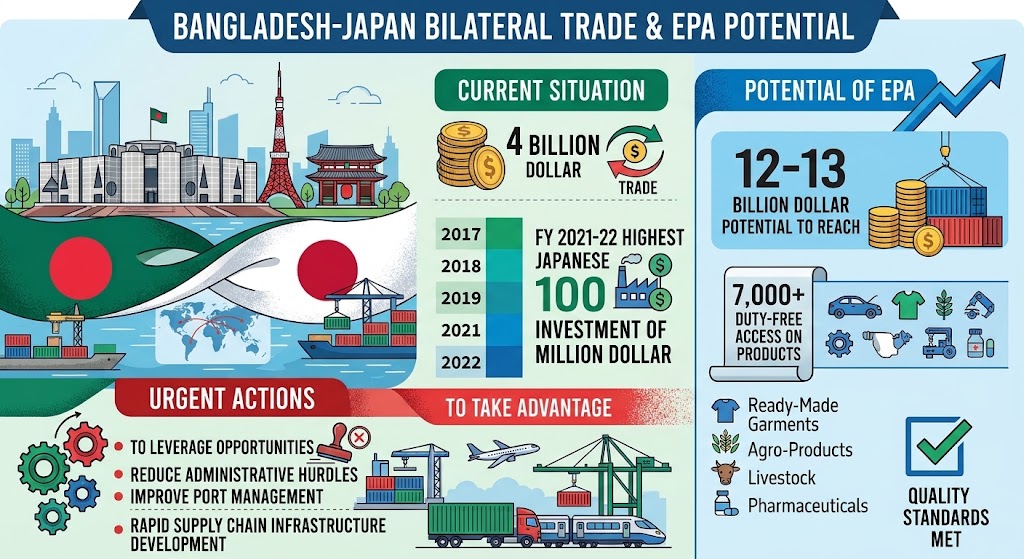
According to Alam, annual trade between Bangladesh and Japan currently stands at around $4 billion. If the EPA takes effect, bilateral trade could double or triple over the next few years, reaching $12–13 billion.
However, achieving that target will depend on Bangladesh’s ability to utilise the agreement’s benefits, maintain product quality and increase export capacity, he said.
Alam said the business community had high expectations for the prime minister’s visit to Japan, scheduled for October 26. He expressed hope that discussions would cover the progress of Japanese-assisted infrastructure projects in Bangladesh, future investment and opportunities to deepen bilateral economic cooperation.
Japan’s government and companies are involved in several major infrastructure projects in Bangladesh, including metro rail development, the Matarbari project and airport-related initiatives.
Discussions on the implementation of these projects and future cooperation could further strengthen economic ties between the two countries, he said.
Alam also described the EPA as an important step towards expanding bilateral trade. According to him, the agreement is awaiting approval from the governments of both countries. He expressed hope that the prime minister’s visit would help advance the approval process and facilitate its implementation.
Bangladesh’s export earnings remain heavily dependent on the ready-made garment industry. Alam stressed the need to diversify exports and develop other sectors with strong growth potential.
He identified agro-processing, agricultural and livestock-based products, and pharmaceuticals as areas where Bangladesh could expand its presence in Japan.
To achieve this, businesses must increase production capacity and manufacture goods that meet the specific requirements of Japanese consumers and importers.
Product quality, food safety, quality control and international certification are particularly important for entering the Japanese market. In agricultural and livestock-based sectors, exporters must comply with the importing country’s regulatory requirements. Without meeting these standards, tariff concessions alone may not be sufficient to increase exports.
Alam said the EPA could offer duty-free access for more than 7,000 products. However, the precise benefits available to individual products will need to be confirmed by examining the agreement’s detailed provisions.
Bangladesh must also consider the continuity of existing trade preferences and how future changes could affect its export competitiveness.
Despite the potential for greater Japanese investment, administrative complications, lengthy approval procedures and limitations in port and logistics infrastructure remain significant challenges, Alam said.
Establishing and operating a business often requires multiple approvals and administrative formalities, increasing investors’ expenditure of time and money. Delays in customs clearance and other import-export procedures also raise business costs and disrupt commercial activities.
Alam emphasised the need to ensure effective implementation of government initiatives, including one-stop services for investors. Introducing new policies or services is not enough, he said; investors must be able to obtain the necessary approvals and assistance quickly and efficiently.
According to figures cited by Alam, Japanese investment in Bangladesh reached approximately $100 million in fiscal year 2021–22, the highest level during the preceding five fiscal years.
He expressed optimism that the EPA could strengthen economic relations and encourage more Japanese companies to invest in Bangladesh.
To maximise the benefits of the EPA, Bangladeshi businesses must increase production capacity, maintain international quality standards, obtain necessary certifications and assess market demand. Improvements in port operations, customs procedures and logistics are also essential.
Alam said the Japan-Bangladesh Chamber of Commerce and Industry had prepared a research report outlining the potential benefits, priorities and necessary steps related to the EPA. The report was submitted to the Bangladesh government and the Japanese embassy following nearly two years of negotiations between the two governments before the agreement was signed.
The chamber has also been working to promote bilateral trade through discussions, seminars and workshops focused on commercial opportunities and existing challenges.
Once the agreement’s full terms are available, the chamber plans to identify promising sectors and develop practical strategies to increase exports, he said.
Bangladesh’s next steps should be determined through an assessment of the agreement’s detailed provisions and the requirements of the Japanese market.
Tariff-free access alone does not guarantee export growth. The country’s ability to supply quality products at competitive prices, maintain efficient logistics and comply with international standards will ultimately determine how successfully Bangladesh can expand its presence in Japan.
What do you feel about this post?

Like

Love

Happy

Haha

Sad