
Madaripur Reporter:
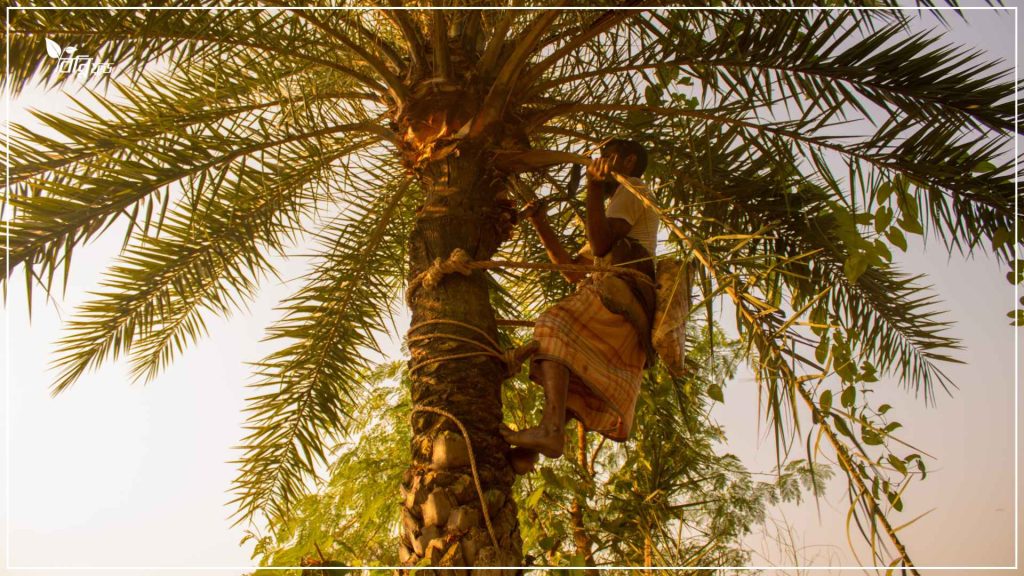
Madaripur once had around 1.2 million date palm trees across its 58 unions, producing jaggery worth an estimated Tk 180 million each season and supporting the livelihoods of nearly 30,000 families. But the number of trees has declined sharply over the years, reducing sap collection and jaggery production. Many traditional tree tappers, known locally as gachhis, are abandoning the trade and turning to other occupations, including rickshaw driving.
Alongside the shortage of trees, concerns have also emerged over the taste and quality of the district’s traditional date palm jaggery. Locals allege that, because of a shortage of pure date palm sap, some producers are mixing sugar and chemical substances into jaggery, affecting its traditional taste and quality.
Residents said rows of date palm trees were once a common sight along roads and in villages across the district. Much of that landscape has now disappeared. They blamed road widening, development activities and the use of date palm trees as fuel in brick kilns for the decline. The loss of trees, they said, is affecting both the local environment and the traditional jaggery industry.
Date palm sap, jaggery and patali have long been part of Bengal’s winter food culture. But the decline in tree numbers has made sap collection increasingly difficult, forcing many gachhis to seek alternative livelihoods. Some have taken up rickshaw driving, while others have moved into different occupations. In the past, tappers would collect sap from trees along roadsides and around homes before dawn and carry it to markets in earthen pots. Finding traditional gachhis in urban areas has now become increasingly difficult.
Despite declining production, demand remains for Madaripur’s traditional madhukhanda and patali gur, made from date palm sap in Sadar, Kalkini, Rajoir and Shibchar upazilas. Locals say the district’s jaggery has earned a reputation beyond Bangladesh and has been sent to various parts of the country as well as Italy, Dubai, Saudi Arabia, Malaysia, London, Kuwait, India, Australia and the United States for more than three decades.
While small pieces of patali jaggery were once more common, larger, plate-shaped varieties weighing between 2.5 and five kilogrammes have gained popularity. Locally, these are known as madhukhanda. Besides being sold in markets, the products are also sent to relatives and acquaintances through courier and postal services.
The Purankourt area of Madaripur town becomes a busy centre for patali jaggery sales during winter, with trading continuing from morning until night. The product is also available at markets in Puran Bazar, Itearpul, Chourasta and Mostafapur.
Enamul Hossain, who was shopping for jaggery in Purankourt, said its quality had deteriorated.
“Nowadays, the quality of jaggery has declined. As sugar is used to make it, the taste is no longer what it used to be,” he said.
Zainal Hossain, a patali jaggery seller from Mostafapur in Madaripur Sadar upazila, said production costs had increased.
“Prices were much lower in the past. But the shortage of fuel has pushed up the cost of making patali jaggery. Besides, as the number of trees has declined, we have to buy sap from gachhis at higher prices,” he said.
Another seller, Sobahan Hossain, said patali jaggery was currently selling for Tk 200 to Tk 600 per kilogramme, depending on its variety. Although prices are high, customers continue to buy their preferred products. He expects prices may fall slightly as winter becomes colder.
Several gachhis, including Anwar Hossain, Dulal, Kashem and Fazal, said they once earned a good living by collecting and selling date palm sap and jaggery. But the use of date palm trees as fuel in brick kilns has contributed to the decline in their numbers, they alleged. They said it had become increasingly difficult to support their families through the trade, forcing them to seek other work.
Kalam Munshi, a former gachhi, said the disappearance of trees along roadsides had forced him to leave the profession.
“There used to be many date palm trees along the roads. Now they are gone. So I have left this profession,” he said.
Rajon Mahmud, founding director of the Madaripur-based environmental organisation Friends of Nature, said the district’s soil was suitable for date palm cultivation.
“Jaggery is made here from the sap of trees that grow naturally, often without proper care. If date palm trees are cultivated separately on a larger scale, they could create employment opportunities for unemployed young people. Exporting jaggery could also help earn foreign currency,” he said.
Md Al-Amin, assistant agriculture officer of Madaripur Sadar upazila, said date palm trees generally grew naturally in the district and were not cultivated commercially.
“That is why trees are being destroyed faster than new ones are growing. This is causing their numbers to decline at an alarming rate. If initiatives are taken to plant more date palm trees to preserve this tradition, it may be possible to restore its former prominence,” he said.