
Tanvir Raihan:
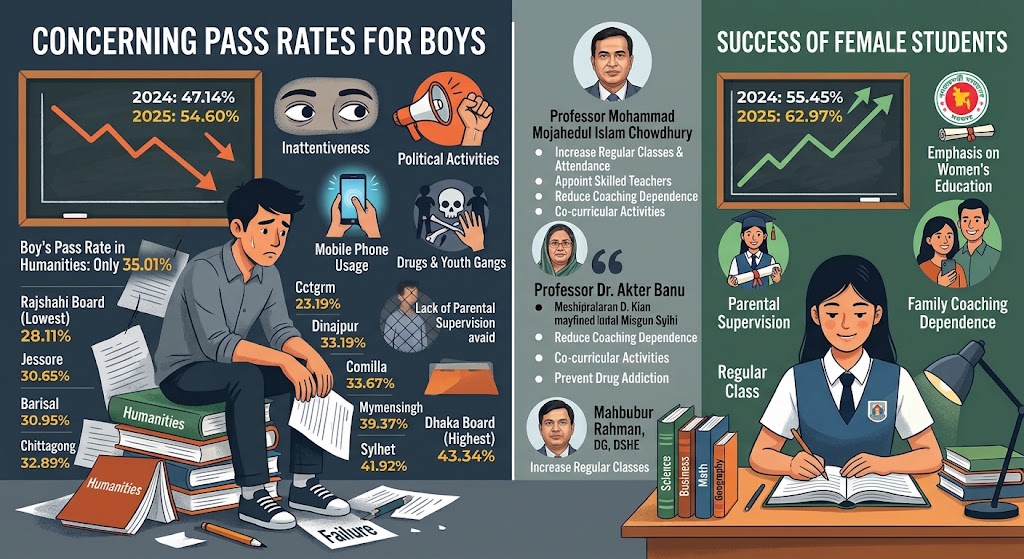
Boys are increasingly falling behind in higher secondary education, with the latest Higher Secondary Certificate (HSC) and equivalent examination results revealing a significant performance gap between male and female students. The situation is particularly concerning in the humanities group, where the pass rate among boys has dropped to an alarming level.
Educationists attribute the trend to declining interest in studies, inadequate supervision by parents and teachers, involvement in political activities, excessive mobile phone use and the growing influence of drugs and juvenile gangs.
Of the 1,048,530 students who appeared in this year’s HSC and equivalent examinations, 483,191 were boys. Only 227,789 of them passed, resulting in a pass rate of 47.14 per cent. This means more than half of the male candidates failed to pass. In contrast, the pass rate among female students stood at 55.45 per cent.
The gender gap was also evident last year. In 2025, the pass rate among boys was 54.60 per cent, compared with 62.97 per cent among girls. The figures indicate that boys have continued to perform worse than girls for two consecutive years.
A group-wise analysis of the results shows that male students performed worst in the humanities group, where their pass rate stood at just 35.01 per cent.
Among the nine general education boards, Rajshahi recorded the lowest pass rate for boys in humanities at 28.11 per cent. The corresponding rate for girls in the same group was 46.05 per cent.
The pass rates for male humanities students were 30.65 per cent in Jashore, 30.95 per cent in Barishal, 32.89 per cent in Chattogram, 33.19 per cent in Dinajpur, 33.67 per cent in Cumilla, 39.37 per cent in Mymensingh and 41.92 per cent in Sylhet. Dhaka recorded the highest rate at 43.34 per cent.
Professor Mohammad Mozahidul Islam Chowdhury, principal of Chattogram Government College, believes girls are currently more attentive to their studies than boys. He said the government’s emphasis on female education, alongside comparatively closer supervision by families, had contributed to girls achieving better results.
He said classroom attendance had become less regular during the Covid-19 pandemic, while dependence on coaching centres began to increase during that period. Subsequent political instability and student movements on campuses also contributed to declining attention to academic activities, with boys being comparatively more affected.
According to him, reduced supervision by educational institutions and teachers at the higher secondary level has encouraged some male students to rely on socialising and coaching-based preparation instead of regular academic studies.
Male students, however, performed comparatively better in the science group, where their pass rate stood at 73.12 per cent. Dhaka recorded the highest rate at 80.97 per cent. In the business studies group, the pass rate among boys was 45.94 per cent.
The influence of social and family environments is also evident in individual student experiences.
Zahirul Islam, who appeared in this year’s HSC examination from the humanities group at a private college in Madaripur, failed to pass. His mother, Rebeka Akter, said her son became involved in political activities soon after enrolling in college. He gradually lost interest in studies as much of his time was spent on politics and mobile phones.
Despite hiring a private tutor and making repeated efforts to bring him back to his studies, she said, the situation did not improve.
Rebeka Akter said she had eventually decided to send her son abroad. She also called for stricter restrictions on students’ involvement in political activities and mobile phone use up to a certain age.
Professor Dr Akhtar Banu of the Institute of Education and Research at Rajshahi University believes prolonged school closures during the Covid-19 pandemic, the introduction of online education, shortened syllabuses and the practice of automatic promotion have negatively affected students’ learning habits.
she said excessive marks awarded under the creative assessment system had encouraged students to expect good results without adequate preparation. This had weakened their perseverance and interest in in-depth learning.
She also identified political changes, student movements, irregular classroom sessions and excessive dependence on coaching centres as factors undermining educational standards. Irregularities in teacher recruitment and the appointment of comparatively less-skilled teachers had further affected the quality of education, she added.
To address the situation, she stressed the need to ensure regular classes, increase student attendance and reduce dependence on coaching centres. She also called for effective measures to tackle juvenile gangs, drug abuse and the deterioration of law and order.
Professor Dr Khan Moinuddin Al Mahmud Sohel, Director General of the Directorate of Secondary and Higher Education (DSHE), acknowledged that boys’ academic performance had been declining for several years.
He attributed the trend to a lack of attention to studies and inadequate supervision by parents and teachers, among other factors.
He said the government was taking initiatives to improve the overall quality of education by increasing classroom attendance, recruiting skilled teachers and encouraging children and adolescents to participate in sports and extracurricular activities.
These initiatives are also expected to help prevent drug addiction and restore students’ interest in education, he added.