
JU Reporter:
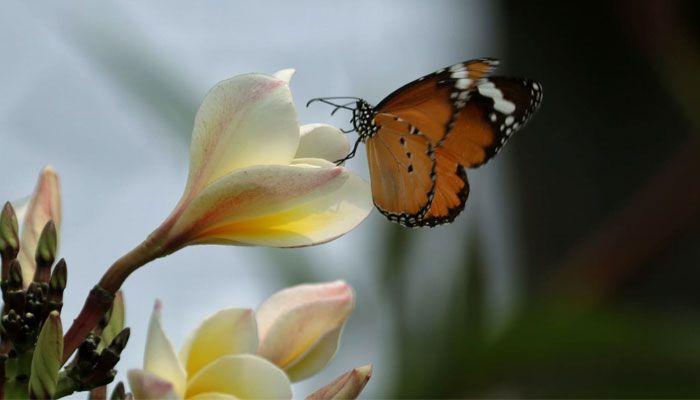
A butterfly fluttering among flowers or resting on a leaf may appear to be a small element of nature’s beauty. But behind its colourful wings lies a complex life cycle closely linked to specific plants. Without suitable plants for laying eggs and feeding their larvae, many butterfly species cannot complete their life cycles.
A study conducted at Ram Pahar and Sita Pahar in Kaptai National Park in Rangamati has highlighted this close relationship between butterflies and plants. Researchers from Jahangirnagar University (JU) identified 87 butterfly species belonging to nine families and documented 103 species of larval host plants from 41 families.
The findings highlight the importance of conserving not only forest habitats but also the plant diversity that supports butterfly populations throughout their life cycles.
The research was conducted by Professor Md Monwar Hossain and researcher Selina Sultana of the Department of Zoology at Jahangirnagar University. Titled “Checklist of Butterfly Larval Host Plants and Their Spatial Distribution at Ram Pahar and Sita Pahar of Kaptai National Park, Bangladesh”, the study was published in the Asian-Australasian Journal of Bioscience and Biotechnology on December 14, 2025.
The researchers collected data between March 2023 and April 2025, surveying eight designated locations in the national park to document larval host plants and their distribution.
Butterflies are commonly associated with colourful wings and their presence around flowers. However, a significant part of their life cycle takes place among leaves and plants.
After hatching from eggs, caterpillars feed on specific plants before developing into adult butterflies. Many butterfly species also select particular plants on which to lay their eggs. These plants, known as larval host plants, provide essential food and suitable conditions for the early stages of their development.
The study identified 103 host plant species, with the Fabaceae family accounting for the highest number at 23 species.
The list includes familiar plants such as mango, blackberry, cashew, custard apple, akanda, tamarind, banyan, drumstick, lime and turmeric.
These findings demonstrate how plants that serve human needs can also play important roles in supporting forest biodiversity. A tree that provides fruit, shade or medicinal resources may simultaneously provide food and shelter for butterfly larvae.
Of the 87 butterfly species identified, 28 belonged to the family Lycaenidae, making it the most represented group.
The study also recorded 15 species from Nymphalidae, 11 from Papilionidae, 10 each from Hesperiidae and Pieridae, seven from Danaidae and four from Satyridae. One species each was identified from Amathusiidae and Acraeidae.
According to the researchers, the findings provide an important picture of butterfly diversity in the forest. More importantly, identifying the relationships between butterfly species and their host plants can help develop conservation strategies based on the ecological needs of individual species.
The researchers found considerable differences in the distribution of host plants across the eight study locations in Kaptai National Park.
Jamai Chora recorded the highest number, with 97 host plant species. Shilchori had 90 species, Thandachori 89 and Bangchori 88.
Meanwhile, 83 species were recorded at Sita Mandir, 78 at Wagga Chora, 75 at Bazar Chora and 67 at Ronir Chora.
The variation suggests that different parts of the same forest may offer different ecological conditions and resources for butterflies.
A plant species found abundantly in one location may be scarce or absent in another. Consequently, habitats across the park may not provide equally suitable conditions for butterfly species that depend on particular host plants.
However, a higher number of host plant species does not necessarily mean that an area is the most suitable habitat for butterflies. Factors such as weather, seasonal changes, flowering patterns, sunlight and humidity can also influence butterfly distribution.
Butterflies contribute to forest ecosystems in several ways. Some species help pollinate flowers while collecting nectar, and their eggs, caterpillars and adult forms serve as food for various other animals.
They are therefore part of the interconnected food webs that sustain forest ecosystems.
The loss of a particular host plant can disrupt the life cycle of butterflies that depend on it. Even if adult butterflies remain visible in an area, a shortage of suitable plants for egg-laying and larval development may affect their long-term reproduction.
This makes the conservation of native plants, shrubs and climbers particularly important.
The findings suggest that forest conservation should not be assessed solely by the number of trees planted or the total area covered by forest. The types of plants present and their ecological relationships with local wildlife must also be considered.
An earlier survey conducted between November 2013 and August 2014 documented 146 butterfly species belonging to 10 families in Kaptai National Park.
The latest study, however, recorded 87 species from nine families.
Researchers cautioned against interpreting the difference as evidence of a decline in butterfly diversity, saying that variations in research objectives, survey methods, sampling areas and study periods must be considered before making such comparisons.
Professor Md Monwar Hossain said, “A comparison with the previous study requires consideration of the research methods and the scope of sampling. The present study did not simply identify butterfly species; it also examined the plants on which they lay eggs and their relationships with those plants. Because of differences in research objectives and methodology, some species may not have been included in the current list.”
The researchers believe that habitat destruction, declining vegetation and climate change can adversely affect butterfly diversity.
Professor Hossain said that human settlements, agricultural activities, shifting cultivation and timber extraction in forest areas could reduce butterfly habitats and the availability of plants suitable for egg-laying and larval development.
He said, “The expansion of human settlements, agricultural activities, shifting cultivation and timber extraction in forest areas can reduce butterfly habitats and the availability of plants and shrubs suitable for egg-laying. Changes in forest cover, deforestation, fires, pollution and changes in land use can also put pressure on butterfly habitats. If the distribution of certain host plants becomes restricted as a result of these changes, the food supply and breeding opportunities for butterflies dependent on them may also decline.”
The Kaptai study offers more than a checklist of 87 butterfly species and 103 host plants. It provides an insight into the interdependence of plants and insects within a forest ecosystem.
Its findings underline the importance of protecting the natural vegetation that supports the life cycles of butterflies. Conserving a forest, the study suggests, means protecting not only its trees but also the intricate relationships among the plants, insects, birds and other wildlife that make it a living ecosystem.