
Tanvir Raihan:
Bangladesh’s economy continues to expand, but employment growth is failing to keep pace with the rising number of people entering the labour market. Around two million young people join the workforce every year, while a World Bank forecast cited in a report suggests that the country may create only 630,000 new jobs in the next fiscal year.
The widening gap is putting additional pressure on the labour market and raising questions about whether the benefits of economic growth are reaching ordinary citizens through higher employment, income and living standards.
Gross domestic product (GDP) growth, export earnings and industrial output are important indicators of economic progress. However, when economic expansion does not translate into sufficient employment opportunities and improved household incomes, the benefits of growth remain uneven.
According to World Bank research, Bangladesh’s real GDP grew by an average of 6.4 per cent annually between 2010 and 2023. Employment, however, did not increase at a comparable rate.
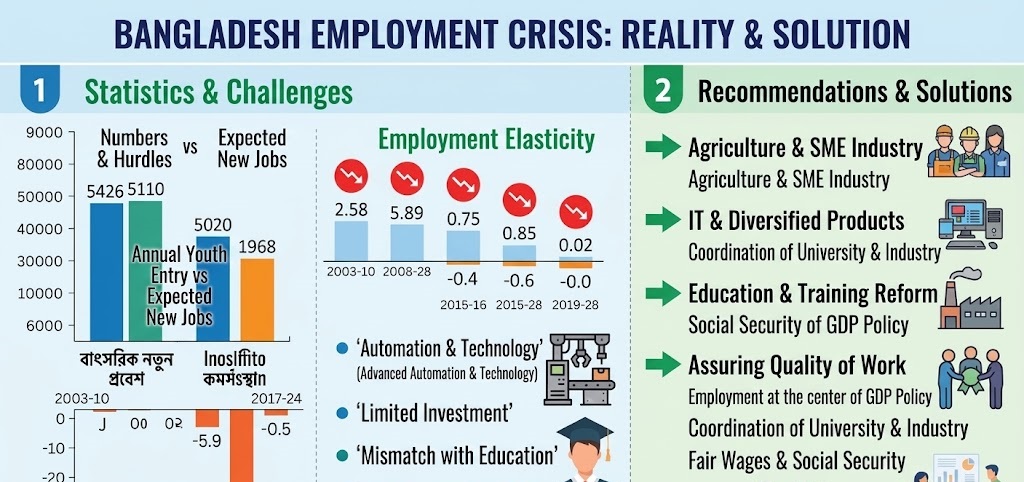
The relationship between economic growth and job creation is measured through employment elasticity, which indicates how employment responds to changes in GDP. According to the figures cited in the report, Bangladesh’s employment elasticity fell from 0.44 in 2003–2010 to 0.22 in 2010–2017 before rising slightly to 0.27 in 2017–2024.
The trend is particularly concerning in industry and manufacturing. Industrial employment elasticity declined from 0.84 in 2003–2010 to minus 0.04 in 2017–2024, while the figure for manufacturing stood at minus 0.10, according to the cited data.
These figures suggest that higher industrial output is not necessarily generating more jobs at the same pace. In some segments, employment may even be declining despite increases in production.
Economists point to automation, weak private investment, energy shortages and a mismatch between workers’ skills and employers’ requirements as possible factors behind the trend. Modern machinery can improve productivity in sectors such as ready-made garments, but without additional investment, market expansion and new production facilities, productivity gains may not lead to sufficient job creation.
High interest rates, limited access to bank financing and uncertainty over gas and electricity supplies are also identified as obstacles to industrial investment. Small and medium-sized enterprises may struggle to expand operations under these conditions, restricting their capacity to recruit additional workers.
Youth unemployment, particularly among educated jobseekers, presents another challenge. Many university graduates struggle to find jobs that match their qualifications, partly because academic programmes and technical training do not always reflect the changing needs of employers. As a result, businesses may face shortages of suitably skilled workers even as educated young people remain unemployed or underemployed.
Dr Khondaker Golam Moazzem Hossain, an economist and chairman of the Knowledge Hub Institute, said economic policymaking needed to move beyond an exclusive focus on GDP growth and place employment creation at its centre.
He stressed the importance of promoting agro-based industries, small and medium-sized enterprises, information technology, diversified export-oriented products and other labour-intensive sectors. He also called for reforms in education and technical training, alongside stronger collaboration between universities and industries to improve the connection between academic qualifications and employment opportunities.
The quality of jobs is equally important. A large number of workers in Bangladesh remain employed in the informal sector, where regular contracts, social protection and workplace safety may be limited. Increasing the number of jobs alone will not be sufficient unless workers also receive fair wages and more secure working conditions.
Bangladesh’s economic performance, therefore, cannot be assessed solely by the size of its GDP. The extent to which growth creates jobs, provides opportunities for young people and improves household incomes and living standards will be crucial in determining whether economic expansion translates into broader prosperity.